
-
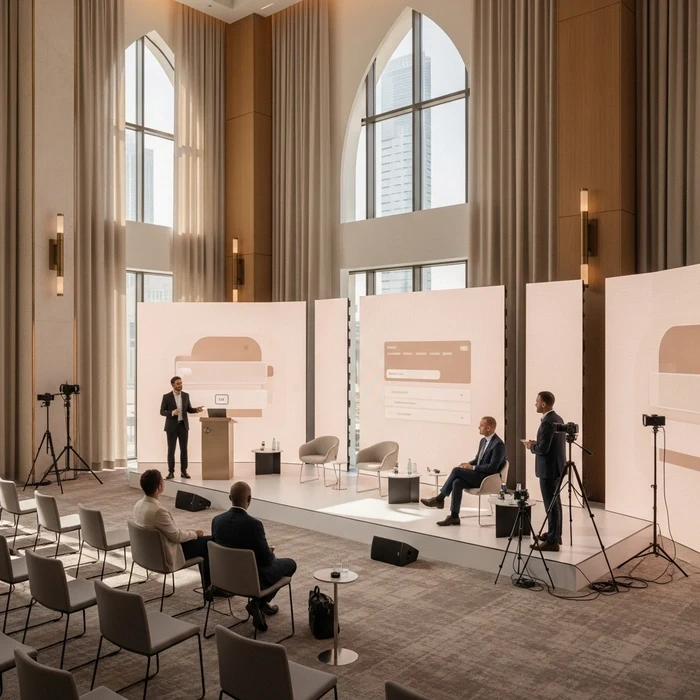
You confirmed the keynote speaker. You locked the date. Then your regional director in Jeddah asks: "Can my team join remotely?" Suddenly, your corporate seminar becomes a hybrid production. Your venue, your budget, and your timeline all need rethinking.
Hybrid corporate events GCC 2026 are no longer experimental. They are the operational default for multinational teams spread across Dubai, Riyadh, Doha, and beyond. But the gap between "adding a livestream link" and delivering a genuine two-audience design is where most corporate events underperform. The shift is structural, not cosmetic.
This guide breaks down what actually changes this year — from venue infrastructure and event platform requirements to hybrid event pricing models and engagement scoring — so you can plan with clarity, not guesswork.
Why Are Hybrid Corporate Events Becoming the Default Format Across the GCC?
Corporate organizations across the UAE, Saudi Arabia, and Qatar now treat hybrid formats as the operational standard. Distributed workforces, cross-border visa logistics, and rising travel costs make full in-person attendance impractical — and excluding remote stakeholders is no longer acceptable for most regional corporate events.
The Workforce Distribution Factor
The GCC Secretariat General reports continued economic integration across member states. That means your product launch in Dubai likely has stakeholders in Dammam, Muscat, and Kuwait City. Flying everyone in is expensive. Excluding them is worse.
The ROI Argument Has Shifted
In 2024, hybrid was a "nice option." In 2026, virtual attendance options directly affect event ROI. Companies now measure success not just by in-room headcount but by total audience metrics. Remote watch time, remote Q&A participation, and post-event recordings and replays engagement all factor into the equation.
Regional Momentum Driving Hybrid Event Trends 2026
Saudi Arabia's Vision 2030 investments have accelerated corporate event activity in Riyadh and Jeddah. Qatar's post-World Cup infrastructure keeps Doha competitive. The UAE remains the regional hub. All three markets now expect hybrid event production as a baseline offering, not a premium add-on. These hybrid event trends 2026 reflect a permanent shift in how the region hosts corporate gatherings.
What Does Two-Audience Design Actually Mean for Your Event?
Two-audience design means planning every element — from stage layout and speaker flow to content delivery and interaction windows — so that both the in-room and remote audiences receive an equally intentional experience, not a secondary afterthought or a passive camera feed.
Beyond the Camera in the Corner
The most common failure in corporate hybrid events UAE is treating the livestream as surveillance footage. A single wide-angle camera pointed at the stage delivers no value to remote participants. Broadcast quality requires multi-camera setups, dedicated switching, and a production team that understands pacing for screens.
Speaker Coaching for Dual Delivery
Your keynote speaker must address two rooms simultaneously. That demands speaker coaching — training presenters to acknowledge the remote audience, repeat in-room questions aloud, and manage eye contact between the live crowd and the camera lens. This is not optional. It defines the remote experience.
The Participant Journey Must Fork
Design separate participant journeys for each audience. The in-room attendee gets networking breaks and physical collateral. The remote attendee gets interactive formats like live polls, breakout video rooms, and on-demand content hubs. Same event. Different experience maps. Both require deliberate planning.
Flaash Expert Insight: When briefing venues for hybrid events, always ask whether the property provides dedicated production rooms adjacent to the main hall — this is essential for managing the remote broadcast without disrupting the live audience.
Which GCC Cities Offer the Strongest Hybrid Event Infrastructure in 2026?
Dubai leads with the widest selection of hybrid-ready hotel and conference venues, while Riyadh is closing the gap rapidly due to Vision 2030 venue investments, and Doha offers premium but more limited options best suited for executive-level corporate events.
Dubai and Abu Dhabi
Hotels like Address Sky View, Atlantis The Royal, and Madinat Jumeirah have invested heavily in fiber-optic backbone upgrades and built-in AV packages. Dubai Internet City and DIFC remain prime locations for tech-forward corporate seminars. Abu Dhabi's Saadiyat Island properties now offer dedicated hybrid production suites.
Network redundancy is critical. Top-tier Dubai venues offer dual ISP failover as standard. Ask for it explicitly in your RFP.









Riyadh and Jeddah
The Riyadh Front, King Abdullah Financial District, and newer properties along King Fahad Road are rapidly deploying hybrid infrastructure. Jeddah's waterfront developments target growing corporate demand. However, latency remains a concern in some older business districts. Always confirm upload speeds before committing.
Doha and Dammam
The West Bay district in Doha provides premium hybrid environments ideal for board meetings and C-suite retreats. In Saudi Arabia's Eastern Province, Dammam's emerging venue market serves oil, gas, and industrial sector events that increasingly require hybrid delivery to global headquarters.
For a deeper look at how these cities compare across formats, see our analysis of GCC corporate event planning trends for 2026.
What Event Platform and Technology Requirements Matter Most?
Your hybrid event platform must support low-latency streaming, real-time interaction tools, audience analytics, and seamless integration with on-site AV — anything less creates a disjointed experience that undermines remote engagement and wastes your production spend.
Streaming Infrastructure
Streaming for corporate events in 2026 demands sub-three-second latency. Platforms like Hopin, vFairs, and ON24 have improved significantly. But the platform is only as good as the venue's upload bandwidth. Target a minimum of 50 Mbps dedicated upload for a single-stream HD broadcast.
Interaction and Engagement Tools
Hybrid event engagement depends on giving remote attendees real agency. Look for platforms that support live polling, moderated Q&A with upvoting, and engagement scoring that tracks individual participation levels. This data feeds directly into post-event reporting and helps justify the hybrid investment.
Integration With On-Site AV
The platform must sync cleanly with the venue's AV stack — camera feeds, slide decks, and audio routing. Mismatches between the platform and on-site hardware are the number one cause of technical rehearsals failure. Research from Harvard Business Review on hybrid meetings confirms that production misalignment is the most cited complaint from remote attendees.
For a full breakdown of technology considerations, explore our guide to the hybrid event technology stack.
Flaash Expert Insight: Always schedule a full technical rehearsal at least 48 hours before the event — not the morning of. This gives your AV team time to resolve streaming issues, test camera angles, and validate platform integrations without last-minute pressure.
How Should You Budget for Hybrid Events in the GCC?
Hybrid events typically cost 25–40% more than equivalent in-person-only events due to production, platform licensing, and additional staffing — but the cost per reached attendee drops significantly when remote audiences are factored into overall ROI calculations.
Where the Extra Budget Goes
The primary cost drivers beyond a standard corporate event are: hybrid event production crew, including camera operators, streaming technicians, and a broadcast director; platform licensing fees; and enhanced internet provisioning. In the UAE and Saudi Arabia, expect additional production costs that vary significantly based on agenda complexity, number of stages, and multilingual requirements.
Hybrid Event Pricing Models to Consider
The most effective hybrid event pricing models for GCC corporates in 2026 include:
Bundled venue and production packages: Some hotels now offer all-in hybrid rates, reducing vendor coordination overhead.
Tiered remote access: Free basic stream with paid premium access including networking, advanced interaction, and gated replays.
Sponsor-offset models: Remote audience analytics and digital screen time create new sponsorship inventory that can subsidize production costs.
Time Zone Advantage
Events hosted in the GCC naturally benefit from favorable time zones. Gulf Standard Time overlaps with European mornings and South Asian afternoons. Plan your live segments during the 10:00–14:00 GST window for maximum cross-regional attendance.
For related perspectives on event innovation, read AI in corporate events in the GCC in 2026 and AI in hybrid events.
How Do You Protect Content Rights and Maximize Post-Event Value?
Establish content rights ownership in every vendor and speaker contract before the event, then leverage recordings as a long-term strategic asset through gated replays, internal training libraries, and lead-generation funnels.
Content Rights Are a Blind Spot
Most corporate event managers negotiate catering and AV. Few negotiate content rights. If your event is streamed and recorded, clarify who owns the footage. Get this in writing. In the GCC, where cross-border IP enforcement may vary, contractual clarity matters.
Recordings as a Strategic Asset
Recordings and replays are not just an archive. They are a content engine. Gate on-demand access behind a registration form and you extend lead generation for weeks. Internal teams can also repurpose keynote clips for onboarding, training, and stakeholder updates.
The ICCA continues to highlight the value of long-term event content and global meeting intelligence, especially as organizers look beyond the live session itself.
Tracking What Matters
Post-event audience metrics should include remote viewer peaks, average watch time, engagement scoring by session, Q&A participation rates, and replay consumption patterns. This data helps teams compare venue choices, production quality, and content effectiveness from one event to the next.
Flaash Expert Insight: When comparing venue proposals for hybrid events, prioritize properties that include AV infrastructure details and confirmed internet speeds in their quotes — this saves time during planning and helps avoid costly changes later.
For more practical reading, see our article on hybrid event trends in the UAE.
What Venue Questions Matter Most for Hybrid Events in GCC Cities?
The right venue can reduce production risk, improve attendee experience, and protect your budget. For hybrid events in Dubai, Abu Dhabi, Riyadh, Jeddah, Doha, or Dammam, venue selection should start with technical suitability, not just room capacity or brand reputation.
Ask About Connectivity First
Before you focus on menus or décor, confirm dedicated internet lines, backup connectivity, and upload speed guarantees. For hybrid formats, network redundancy is often more important than ballroom size.
Check Room Layout Flexibility
Hybrid setups usually require camera positions, control desks, confidence monitors, speaker holding areas, and separate circulation paths for technicians. A venue that works well for a standard seminar may not support an effective hybrid layout.
Understand Acoustic and Lighting Conditions
Poor room acoustics weaken both the live and remote experience. The same applies to low ceilings, mixed lighting, or too much natural backlight behind the stage. These details directly affect broadcast quality.
Clarify Operational Support
Some venues offer in-house AV coordination, while others only provide basic power and access. Knowing this early helps you estimate production complexity and compare proposals more accurately.
Finding the Right Venue Is Where It All Starts
Every decision in this guide — from two-audience design to platform selection to budgeting — connects back to one foundational choice: the venue. The physical space determines your production ceiling, your bandwidth options, and your attendee experience on both sides of the screen.
That is where Flaash helps. Flaash.ae is a free platform for companies looking to find and book corporate event venues across the Middle East. You submit your brief online, and a dedicated project manager comes back within 24–48 hours with 3–5 turnkey venue proposals and detailed quotes tailored to your needs.
Whether you are planning in Dubai, Abu Dhabi, Riyadh, Jeddah, Doha, or Dammam, Flaash helps you shortlist venues that fit your event format, audience profile, and technical requirements.
If you are planning a hybrid corporate event in 2026, start with the venue. Explore options at www.flaash.ae/blog/events/hybrid-corporate-events-gcc-2026 and use Flaash to find a corporate venue that is ready for both the room and the screen.
FAQ: hybrid corporate events GCC 2026
What is a hybrid corporate event in the GCC in 2026?
A hybrid corporate event in the GCC is a meeting, conference, or launch that combines an in-person audience with a live virtual component so remote participants join in real time. In 2026 GCC hybrid events are commonly used to reach regional and global stakeholders while complying with local venue and tech standards.
Which GCC cities are best for hosting hybrid corporate events in 2026?
Top GCC cities for hybrid corporate events in 2026 are Dubai, Riyadh, and Abu Dhabi. Dubai leads with MICE infrastructure and global connectivity, Riyadh is rapidly expanding event capacity under Vision 2030, and Abu Dhabi offers modern convention centres and strong AV/IT support.
What technology and connectivity do hybrid corporate events in the GCC require?
Essential technology includes robust high-bandwidth internet, professional AV and streaming gear, a reliable webinar or streaming platform, audience engagement tools such as polling, Q&A, and networking, and on-site technical support. Also plan for redundancy, translation if bilingual, and secure streaming to meet Gulf data and privacy expectations.
How much do hybrid corporate events in the GCC cost in 2026?
Costs vary widely. Small hybrid meetings can start in the low five figures, while large regional summits range from tens of thousands to $200k+ depending on venue, production quality, streaming scale, talent, and localization. Key cost drivers include venue and catering, AV and production, platform licensing, and content or interpretation services.
How can organizers maximize engagement and ROI for hybrid corporate events in the GCC?
Focus on interactive formats such as live polls, breakout sessions, and networking lounges, schedule sessions for regional time zones, offer on-demand content after the event, use lead capture and analytics to measure conversions, and localize content in Arabic and English to boost attendance and sponsorship revenue.
How do I choose the right hybrid-ready venue and vendors in the GCC for 2026?
Evaluate venues for dedicated bandwidth, on-site AV and IT teams, studio or broadcast spaces, backup power, and compliance with local permits. For vendors, check proven hybrid production experience, security and compliance, language support, and rehearsal policies. Issue a clear RFP with technical requirements and run a full technical dry run before the event.
Recent Posts

Load More Blogs