
-
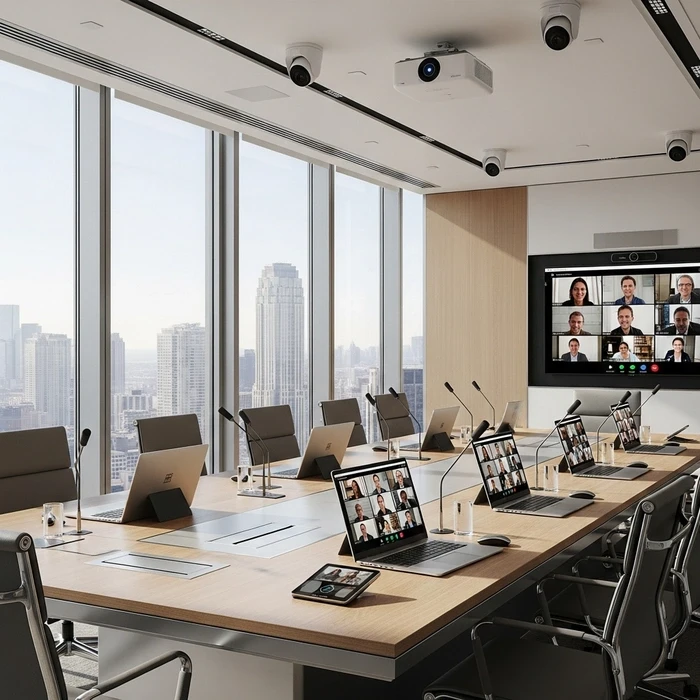
You invested six figures in a hybrid product launch at a five-star Dubai venue. The in-room experience was flawless. But your 400 remote attendees experienced buffering, audio dropouts, and a registration flow that crashed mid-event. The problem was not the venue. It was your technology stack.
In the Middle East's corporate events market, hybrid is no longer experimental. It is the default format for board meetings, investor briefings, and regional product launches across the UAE, Saudi Arabia, and Qatar. Live streaming for corporate events now carries the same production expectations as broadcast television. Yet most organizations still assemble their hybrid event technology stack reactively, stitching together tools weeks before the event without testing interoperability.
This guide breaks down every layer of the stack, from encoding to analytics, with the specificity that corporate event planners across the GCC actually need.
What Exactly Constitutes a Hybrid Event Technology Stack in 2026?
A hybrid event technology stack is the integrated set of hardware, software, and connectivity layers that deliver a seamless experience to both in-person and remote audiences simultaneously. It spans streaming infrastructure, AV gear, engagement platforms, registration systems, and analytics tools working in concert.
Hardware Layer vs. Software Layer
The stack divides into two interdependent layers. The hardware layer includes cameras, microphones, encoders, switchers, and on-site network infrastructure. The software layer covers your hybrid event platform, streaming distribution, attendee apps, and data dashboards. Neither layer works in isolation. A premium PTZ camera means nothing if your encoder cannot handle the bitrate your CDN requires.
Why the "Stack" Mindset Matters
Treating each tool as a standalone purchase is the most common mistake. When your registration system does not pass data to your analytics dashboard, you lose attribution. When your streaming platform cannot integrate with your event app for hybrid events, engagement drops. The stack mindset forces you to evaluate interoperability before capability.
Research from Harvard Business Review on running effective hybrid meetings confirms that technology coherence, not individual tool quality, determines participant experience.
What Are the Non-Negotiable AV Requirements for Hybrid Corporate Events?
The non-negotiable AV foundation includes broadcast-grade cameras, a dedicated audio mix-minus configuration, hardware encoders with RTMP output, and a redundant internet connection with minimum 50 Mbps dedicated upstream. Skipping any one of these creates a single point of failure.
Camera and Switching Setup
For a corporate seminar at venues like the Rosewood Abu Dhabi or the Four Seasons Riyadh, you need at minimum two PTZ cameras and one wide-angle fixed camera. Camera switching should be handled through a dedicated production switcher, not software-based switching on a laptop. Software switching introduces latency and instability during multi-hour sessions.
Audio: The Most Underestimated Element
Audio quality matters more than video for remote attendees. A proper audio mix-minus setup ensures remote participants hear the room without echo or feedback loops. Ceiling microphones in hotel ballrooms rarely deliver broadcast-grade audio. Insist on lapel microphones for speakers and boundary microphones for panel setups. This is a core element of any serious hybrid event AV requirements checklist.
Encoding and Streaming Protocol
Use hardware encoders that support RTMP or SRT protocol. Software encoders like OBS are adequate for webinars but unreliable for high-stakes corporate events. Your encoder feeds into a CDN that distributes the stream globally. For events with audiences across the GCC, Europe, and Asia, select a CDN with edge servers in Dubai, Riyadh, and Singapore at minimum.
Flaash Expert Insight: At properties in KAFD (King Abdullah Financial District) in Riyadh, always confirm dedicated fiber availability 48 hours before the event. Shared hotel Wi-Fi will not sustain broadcast-grade streaming, regardless of what the venue sales team promises.
If you are evaluating venue-level readiness, our AV readiness checklist for event venues in the UAE covers the full technical audit process.
How Do You Build Redundancy Into Your Streaming and Connectivity?
Build redundancy by deploying dual internet circuits from separate ISPs, a backup encoder on hot standby, and a secondary CDN ingest point, ensuring zero single points of failure across the entire streaming chain. Redundancy is not optional for executive-level events.
Dual Internet: Separate ISPs, Separate Paths
Redundant internet means two physically separate connections. Two connections from the same ISP sharing the same last-mile infrastructure is not redundancy. At venues like the Mandarin Oriental Doha or Jumeirah Emirates Towers Dubai, request a dedicated leased line alongside the venue's primary fiber. Bond them using a hardware failover device.
Encoder and Stream Failover
Your primary hardware encoder should feed the CDN. A second identical encoder should run simultaneously on the backup internet line, feeding a secondary ingest URL. If the primary drops, the CDN switches to the backup feed within seconds. This is standard practice in broadcast but still rare in corporate event production. Stream health monitoring dashboards let your technical director watch bitrate, frame drops, and latency in real time.
On-Site Power Redundancy
Do not overlook electrical redundancy. A UPS (uninterruptible power supply) on every critical device, including encoders, switchers, and streaming laptops, protects against the brief power flickers common during AV-heavy setups in hotel ballrooms.
Which Registration and Engagement Tools Complete the Stack?
The right registration and engagement tools unify the attendee journey by connecting sign-up data, access credentials, live interaction, and post-event analytics into a single trackable pipeline. They are not add-ons. They are core stack components.
Registration: Beyond a Sign-Up Form
Hybrid event registration tools must handle divergent attendee journeys. In-person attendees need QR-coded badges and check-in flows. Remote attendees need secure backstage links, unique stream access URLs, and calendar integrations. The registration platform must distinguish between these paths and pass audience-type data downstream to your analytics layer.
Look for platforms supporting SSO (Single Sign-On) integration, especially for internal corporate events where attendees authenticate through Microsoft Entra ID or Okta. Data privacy compliance with UAE PDPL and Saudi Arabia's PDPL is non-negotiable for any platform handling attendee PII in the region.
Live Engagement: Polls, Q&A, and Interpretation
An event app for hybrid events must synchronize engagement features across both audiences. When a remote attendee submits a question, the in-room moderator should see it on the same dashboard as in-room questions. Polling results should display on the venue's screens and the live stream simultaneously.
For multilingual corporate events, common across the GCC, your stack must support live interpreters via dedicated audio channels and real-time captions. Arabic-English interpretation is a baseline requirement for government-adjacent and semi-governmental events in KSA and Qatar.
To deepen your approach to attendee engagement tools, our guide on integrating attendee engagement apps in corporate events covers platform selection criteria in detail.
Flaash Expert Insight: For investor briefings and board meetings, always verify that your engagement app offers device compatibility across iOS, Android, Windows, and browser-based access. Decision-makers will not download a dedicated app for a 90-minute session.









How Should You Integrate Video Conferencing With Live Production?
Integrate video conferencing by routing platforms like Zoom or Teams through your production switcher via NDI or HDMI capture, giving your production team full control over when and how remote speakers appear on the live stream. Never let the conferencing UI appear on your broadcast output.
The NDI Bridge Method
Video conferencing integration in hybrid events requires a production bridge. Remote speakers join a standard Zoom or Teams call. Your production team uses NDI (Network Device Interface) to extract individual speaker video feeds. These feeds enter your production switcher alongside in-room cameras. The result: your remote panelist appears with the same visual quality and switching control as your on-stage speakers.
Audio Routing for Remote Speakers
This is where most productions fail. The remote speaker's audio must enter your in-room PA system and your live stream mix. But the remote speaker must not hear their own audio returned, which creates echo. This requires a proper audio mix-minus configuration on your audio mixer. It sounds simple. In practice, it requires careful routing and testing at minimum two hours before doors open.
Recording Architecture
Hybrid event recording setup should capture three separate outputs: the program feed (what the live stream audience sees), an ISO recording of each camera, and a screen capture of all presentation content. This gives your post-production team maximum flexibility for on-demand content, highlight reels, and compliance archives. Store recordings on region-local cloud infrastructure to comply with GCC data residency requirements.
How Do You Measure ROI Across the Entire Hybrid Event Technology Stack?
Measure ROI by unifying registration data, stream analytics, engagement metrics, and post-event survey scores into a single dashboard, then mapping each data point to pipeline impact and cost-per-attendee benchmarks. Vanity metrics like total views are insufficient.
The Metrics That Actually Matter
Track these across both audiences:
Unique authenticated viewers (not total views)
Average watch time and drop-off points
Engagement rate (poll participation, Q&A submissions, resource downloads)
Lead qualification scores passed to CRM
Cost per engaged attendee (total tech spend divided by actively engaged participants)
Connecting the Stack to Your CRM
Your hybrid event production tools generate valuable intent data. Which sessions a remote attendee watched, how long they stayed, and whether they downloaded materials should all flow into your CRM. Look for platforms with native Salesforce or HubSpot integrations. Manual CSV exports are a sign your stack has gaps.
For a deeper framework on connecting event data to business outcomes, explore our event ROI dashboard methodology.
Post-Event Content as ROI Multiplier
A well-architected hybrid event recording setup turns a single event into weeks of content. Session recordings become gated assets. Highlight clips fuel LinkedIn campaigns. Transcript data feeds SEO content. The technology stack you build for the live event should be designed from day one to maximize this post-event content yield.
Flaash Expert Insight: Allocate 15-20% of your total hybrid event technology budget to post-production and content repurposing. The ROI from on-demand content routinely exceeds the live event itself within 60 days.
Your Stack Is Your Competitive Advantage
The difference between a forgettable hybrid event and one that drives measurable pipeline is not creativity or catering. It is the hybrid event technology stack underneath it. Every decision, from encoder selection to CRM integration, either compounds reliability or introduces risk.
Corporate event planners across Dubai, Riyadh, and Doha are operating in a market where executive expectations are set by broadcast television, not by webinar platforms. Build your stack to that standard. Test it ruthlessly. Measure everything.
Flaash sources and produces hybrid corporate events across the UAE, Saudi Arabia, and Qatar. If you need a partner who speaks fluent AV and fluent boardroom, start a conversation with our team.
FAQ: hybrid event technology stack
What is a hybrid event technology stack?
A hybrid event technology stack is the combination of hardware and software tools used to run events that serve both in-person and virtual audiences together.
What are the essential components of a hybrid event technology stack?
Core components are a streaming/virtual event platform, event registration/AMS, AV equipment (cameras, mics, switchers), encoder or streaming service, audience-engagement tools (polls/Q&A/chat), content management, and analytics.
How do I choose the right hybrid event technology stack?
Define goals, audience size, required interactions, integrations, and budget, then prioritize platforms with strong interoperability, scalability, and proven production support.
How much does a hybrid event technology stack typically cost?
Costs vary widely—basic stacks can be a few hundred dollars using consumer tools; professional corporate productions typically run from several thousand to tens of thousands depending on production quality, licenses, and staffing.
How can a hybrid event technology stack improve attendee engagement?
By enabling real-time interaction (polls, live Q&A, breakout rooms, networking lounges), synchronized content for both audiences, and accessible on-demand content to increase participation and satisfaction.
Which platforms are commonly used in hybrid event technology stacks?
Common options include Zoom and Microsoft Teams (meeting-focused), Hopin/vFairs/On24 (event platforms), plus streaming/encoder tools like Vimeo/YouTube/StreamYard and production tools such as OBS or hardware encoders. Choose based on interaction and production needs.



Recent Posts

Load More Blogs