
-
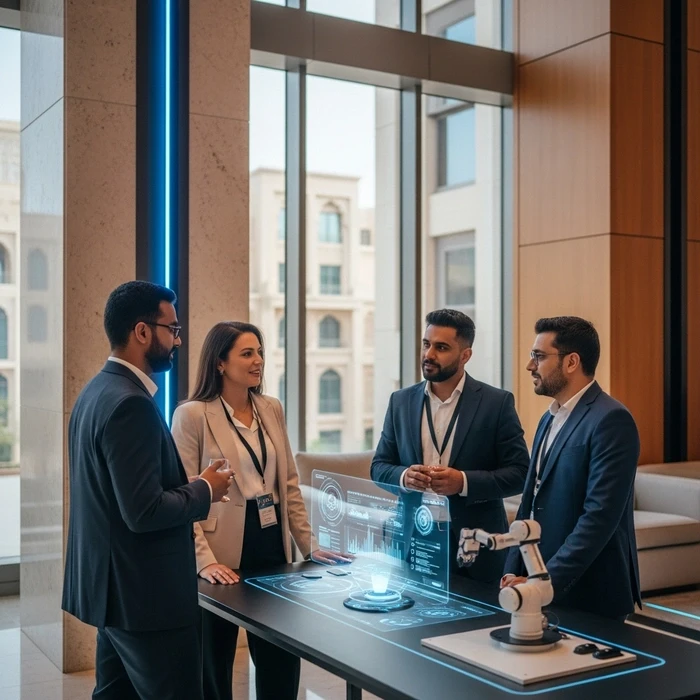
AI is no longer a future topic for event teams in the Gulf. In 2026, it is becoming a practical layer across planning, attendee experience, content production, analytics, and event operations. For corporate events in the UAE, Saudi Arabia, and Qatar, the real question is no longer whether AI matters. It is where it creates useful value, where it needs control, and how teams can apply it without adding complexity.
This is what AI in corporate events GCC 2026 looks like in practice: better planning decisions, more relevant attendee journeys, faster content workflows, stronger reporting, and more operational efficiency. But the best results still come when AI supports professionals rather than replacing them.
For event teams already adapting to wider regional shifts, our guide to GCC corporate event planning trends 2026 gives useful context on the market forces shaping venue, format, and budget decisions.
Why AI matters for GCC corporate events in 2026
Corporate events across the GCC are becoming more data-intensive and expectation-heavy at the same time. Attendees expect relevance, speed, personalization, and smooth logistics. Internal stakeholders expect clearer ROI. Procurement and compliance teams expect more documentation and control. AI helps event teams manage that complexity.
In the Gulf, this is especially relevant because many events operate in multilingual, multi-stakeholder environments. A conference in Dubai may host regional headquarters, international partners, Arabic and English-speaking attendees, and multiple sponsor priorities. A leadership summit in Riyadh may need stronger protocol awareness, approval workflows, and more precise planning timelines. A client event in Doha may require a tighter guest experience and clearer reporting on outcomes.
That is why AI event planning and event automation GCC are gaining traction. Teams are using AI not as a novelty, but as a way to improve decision speed, reduce manual work, and support better experience design.








1. AI event planning: faster decisions before the event starts
One of the strongest 2026 use cases is planning support. Event teams spend a large amount of time comparing options, formatting information, coordinating vendors, and revising schedules. AI can reduce that load when the underlying data is organized.
Smarter brief analysis and recommendation engines
AI tools can now read an event brief and identify likely needs based on audience size, event type, preferred location, and business objective. For example, a board meeting in Abu Dhabi, a product launch in Dubai, and a team offsite in Doha should not trigger the same venue shortlist or setup logic.
With the right inputs, recommendation engines can support:
venue shortlist logic
room setup suggestions
catering pattern recommendations
AV and staging requirements
likely staffing needs
risk flags based on format and timing
This is where better data centralization becomes important. When venue details, previous event requirements, and supplier information are stored in one structured workflow, AI can help surface stronger options faster. That is also why teams looking at automation are increasingly exploring workflows such as AI event RFP automation, where repetitive sourcing steps can be reduced without losing control.
AI agenda optimization
AI agenda optimization is one of the most practical use cases for corporate events with multiple sessions or stakeholder groups. Instead of manually balancing session timing, breaks, room allocation, and audience overlap, AI can model patterns and suggest better sequences.
Useful applications include:
reducing schedule conflicts between related sessions
improving traffic flow between rooms
placing high-demand sessions at stronger times
adjusting break timing based on attendee behavior
matching session length to likely engagement levels
For GCC conferences and internal corporate summits, this matters because event programs often combine executive sessions, breakout tracks, networking windows, and sponsor requirements. AI helps organize the structure, but human planners still make the final call.
2. AI event personalization: making the attendee journey more relevant
Personalization is now one of the clearest differences between average and high-performing events. Attendees are less satisfied with generic programs and broad communications. They want relevance.
Session suggestions and attendee segmentation
AI event personalization starts well before check-in. Based on registration data, role, company type, interests, and historical behavior, AI can improve attendee segmentation and generate more useful session suggestions.
In practice, that may mean:
recommending different sessions to HR leaders and finance leaders attending the same event
tailoring reminder emails by interest track
adjusting in-app content based on behavior
highlighting relevant networking opportunities
surfacing sponsor offers only to matched audience groups
This improves the attendee experience while also helping organizers increase session attendance and engagement.
AI matchmaking events
Networking remains one of the main reasons professionals attend corporate events. But networking only creates value when the matches are relevant. That is why AI matchmaking events tools are becoming more useful in 2026.
Instead of random introductions, AI can suggest meetings based on:
industry overlap
buying intent
company size
mutual interests
stated goals
lead potential
For B2B conferences and hosted networking formats in the GCC, this is especially valuable. It supports more targeted conversations and helps sponsors and commercial teams move beyond vanity metrics.
When paired with lead scoring, matchmaking also improves post-event follow-up. Not every attendee interaction has the same business value, and AI can help event and sales teams prioritize what matters most.
3. AI event content: producing more, faster, with better structure
Content demands around events have increased sharply. Teams now need pre-event promotion, on-site messaging, post-event summaries, social snippets, executive recaps, and internal reporting. This is where generative AI for events has become genuinely useful.
Pre-event content and speaker prep
AI event content tools can support the first draft of:
event descriptions
session titles
agenda summaries
speaker bios
invite emails
reminder sequences
FAQ pages
sponsor copy
They can also support speaker prep by summarizing audience profiles, highlighting regional context, and identifying likely questions or points of interest.
That said, human review is essential. A senior leadership event in Riyadh or Abu Dhabi may involve political, cultural, legal, or protocol sensitivities that require judgment. AI can accelerate preparation, but it should not be the final editor.
Content repurposing after the event
Post-event content is another strong use case. AI can turn recordings and transcripts into:
short summaries
key takeaways
quote cards
article drafts
recap emails
sales follow-up notes
internal knowledge assets
This makes content repurposing faster and more scalable. It also helps teams get more value from each event rather than letting content disappear after one live session.
For teams running mixed in-person and digital touchpoints, our article on AI in hybrid events explores how AI can support continuity across formats.
Translation and captions
In the GCC, multilingual access is not optional for many event formats. Translation and captions powered by AI can support Arabic and English delivery at scale, and in some settings also extend to wider workforce languages. This improves accessibility, inclusion, and clarity.
For internal events, this can make communication more effective. For external events, it can expand reach and improve audience understanding. But quality checks remain important, especially for technical or executive-level content.
4. AI event analytics: from reporting to real-time insights
Analytics is one of the areas where AI can most clearly improve event ROI. Many event teams still rely on post-event reports that are too slow, too broad, or too disconnected from business outcomes.
Real-time insights during the event
AI event analytics can now process live inputs from event apps, check-in systems, engagement tools, polls, and content interactions. This creates real-time insights that allow teams to adjust while the event is still happening.
Examples include:
identifying underperforming sessions
spotting crowd flow issues
measuring app engagement by segment
tracking meeting completion rates
surfacing content consumption trends
flagging drop-off points in the attendee journey
This supports better operational responses and stronger attendee experience.
Lead scoring and follow-up prioritization
For B2B events, post-event success often depends on what happens in the first few days after the event. AI helps by combining event behavior into clearer lead scoring models.
Signals may include:
session attendance
booth interactions
scheduled meetings
questions asked
content downloaded
time spent in certain areas
sponsor interactions
That allows event and sales teams to focus on the most promising follow-ups first. It also helps connect event activity to pipeline outcomes.
To put this into a wider business context, PwC’s analysis of AI in the Middle East highlights the scale of regional value creation expected from AI adoption across sectors.
Better ROI reporting
AI also helps structure event measurement more clearly. Instead of isolated metrics, teams can build more connected reporting around:
attendance quality
engagement depth
meeting effectiveness
sponsor outcomes
content performance
commercial impact
For event leaders under pressure to justify budgets, this is essential. Our article on corporate event ROI benchmarks in the GCC offers a useful framework for evaluating performance in a more practical way.
5. AI in event operations: reducing friction behind the scenes
Not every valuable AI use case is attendee-facing. Some of the most useful gains happen in the background.
Chatbots and workflow support
Chatbots can now handle a large share of routine event questions, including:
registration support
schedule queries
room directions
transport details
dress code questions
policy clarifications
This reduces pressure on event teams and improves response speed for attendees. Internal teams can also use AI assistants to search venue notes, compare supplier information, or retrieve event documentation quickly.
Tool selection and vendor evaluation
In 2026, one challenge is no longer access to tools, but tool selection. There are many AI products in the market, but not all are suitable for GCC corporate events.
Teams should evaluate:
integration with existing systems
language support
regional relevance
privacy and storage practices
reporting depth
transparency in outputs
ease of human review
That is also why structured procurement matters. Our guide to AI vendor evaluation for events can help teams assess solutions more carefully before deployment.
Governance, privacy, bias, and human oversight
AI can improve speed and quality, but it also introduces risk if applied carelessly. In the GCC, governance must be part of the event workflow, not an afterthought.
Data governance and privacy
Data governance is especially important when AI tools process attendee information, meeting data, behavioral signals, or content recordings. Event teams should be clear on:
what data is collected
why it is collected
where it is stored
who can access it
how long it is retained
whether consent is required
This matters for both compliance and trust.
Bias and fairness
Bias and fairness concerns can appear in recommendation systems, matchmaking, lead scoring, and personalization logic. If a model consistently favors certain profiles, companies, languages, or roles, the attendee experience becomes uneven.
Teams should review how outputs are generated and check for patterns that may create unfair results.
Human-in-the-loop
The best way to use AI in events is still human-in-the-loop. AI should support choices, not make every important decision alone. Human review is especially important for:
executive communications
VIP guest handling
sponsor messaging
public-facing content
sensitive networking recommendations
compliance-related outputs
AI can accelerate. People still need to validate.
A practical 2026 approach for GCC event teams
For most organizations, the right path is not to automate everything at once. It is to start with one high-friction workflow and improve it well.
A practical sequence could be:
centralize planning and sourcing data
automate one repetitive workflow
improve attendee segmentation and recommendations
connect analytics to business outcomes
build governance rules before scaling further
This is also where event workflow structure matters. Venue sourcing, supplier information, approvals, and planning data all become more useful when they are not scattered across inboxes and spreadsheets. Better centralization makes AI more accurate and event execution more efficient.
For companies managing corporate events across the Middle East, that foundation matters as much as the AI layer itself. Flaash.ae supports this broader logic by helping teams streamline venue discovery and compare tailored options quickly, with project managers responding in 24–48 hours with 3–5 turnkey proposals. It is a practical example of how better workflow organization can support faster, more confident event decisions without adding unnecessary complexity.
Final thought
The most useful story around AI in corporate events GCC 2026 is not about replacing event professionals. It is about helping them make better decisions, deliver more relevant experiences, and report outcomes more clearly.
The strongest use cases are already visible: AI event planning, AI event personalization, AI agenda optimization, AI matchmaking events, AI event analytics, AI event content, and smarter event automation GCC workflows. But success depends on more than technology. It depends on clean data, sensible processes, good governance, and experienced people making the final call.
In 2026, that balance is what separates AI experimentation from real event performance.
FAQ: AI in corporate events GCC 2026
How is AI transforming corporate events in the GCC in 2026?
AI is automating planning, personalizing attendee experiences, and delivering real-time analytics for measurable ROI. In 2026 GCC events use AI across registration, content recommendation, translation, and post-event reporting to boost efficiency and engagement.
What AI tools and features are most used at GCC corporate events in 2026?
Common tools include chatbots, predictive analytics, AI matchmaking, real-time translation, and crowd analytics. These features help event teams automate support, tailor agendas, improve networking, and monitor footfall at venues in Riyadh, Dubai, and Doha.
How does AI improve attendee engagement and networking at GCC corporate conferences?
AI delivers personalized agendas and intelligent networking suggestions based on attendee profiles and behavior. It also powers live polls, Q&A moderation, and sentiment analysis to increase session relevance and interaction.
Can AI help GCC corporate events meet local privacy and compliance requirements in 2026?
Yes—AI solutions can be configured for regional data residency, consent management, and role-based access to meet GCC regulations. Choose vendors with local hosting options, clear consent flows, and audit logs.
Is adopting AI cost-effective for companies running corporate events in the GCC?
Yes—AI reduces manual labor, improves lead qualification, and increases sponsorship value, often delivering fast payback. Evaluate total cost of ownership, expected efficiency gains, and revenue uplift from better matchmaking and analytics.
What are best practices for implementing AI in corporate events across the GCC in 2026?
Start with a clear objective, pilot one feature such as a chatbot or matchmaking, ensure local compliance, and measure KPIs. Partner with experienced regional vendors, integrate with your workflow, and iterate using real-time event data.



Recent Posts
Load More Blogs