
-
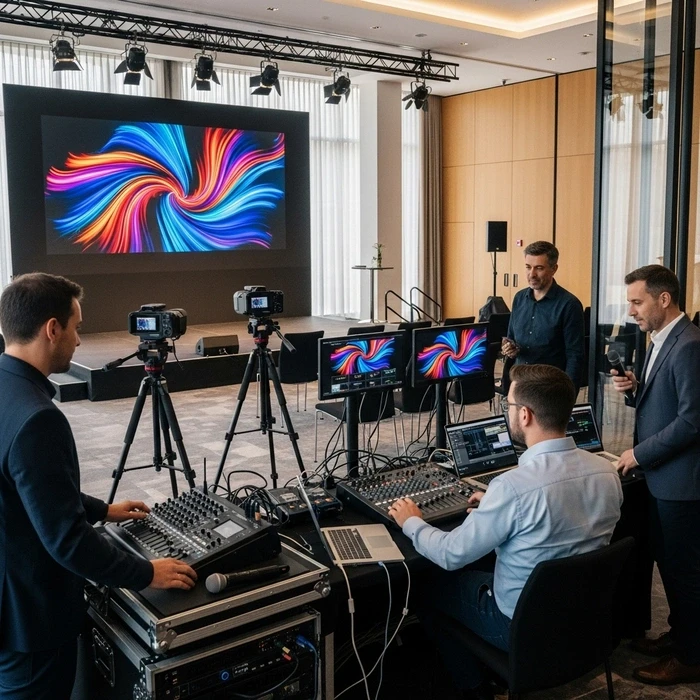
Your CFO approved the budget. The agenda is locked. Speakers are confirmed. Then, two weeks later, your AV partner tells you the venue internet is shared, the encoder is incompatible with your platform, and the virtual audience experience will depend on backup hotspots.
This is exactly why building the right hybrid event tech stack matters.
For corporate teams in the UAE, Saudi Arabia, and Qatar, hybrid events are no longer experimental. They are now a standard format for conferences, leadership meetings, client events, product launches, internal town halls, and industry forums. But success depends on more than choosing a venue and adding a livestream. You need a practical stack that connects production, registration, audience engagement, analytics, and venue infrastructure into one reliable system.
This guide breaks down how Middle East corporates should choose a hybrid event tech stack that is realistic, scalable, and measurable.
What is a hybrid event tech stack?
A hybrid event tech stack is the full combination of tools, platforms, and infrastructure used to run an event for both in-person and virtual attendees.
For most corporate events, that stack includes:
A hybrid event platform Middle East teams can use for streaming and attendee access
A reliable streaming setup for hybrid events
Registration and hybrid event registration tools
An event app for hybrid events
Audience engagement features such as interactive Q&A, polls, and networking
Check-in and badge scanning tools onsite
An event analytics platform for measuring attendance, engagement, and ROI
Security, support, and backup systems
The key point is simple: these tools should work together. A disconnected stack creates friction for your team and a fragmented experience for attendees.
If you want a broader planning framework, start with this guide to hybrid corporate event planning.
Why Middle East corporates need a region-specific approach
A hybrid event in Dubai is not exactly the same as one in Riyadh, Jeddah, Abu Dhabi, or Doha.
Regional conditions matter, including:
Venue internet quality and redundancy
Local AV partner capabilities
Arabic and English attendee journeys
Corporate IT security expectations
Different venue layouts and power configurations
Time zone-sensitive support needs
Data handling and internal compliance requirements
In major business hubs such as DIFC in Dubai, KAFD in Riyadh, and central Doha, venue infrastructure is often strong. But that does not mean every ballroom, conference center, or hotel meeting floor is ready for a production-grade hybrid format.
This is why venue choice and tech choice should happen together. At Flaash.ae, companies can submit one brief and receive tailored venue proposals for corporate events across the Middle East. Because the platform is free for users and built for professional events, it helps teams shortlist venues that fit not only the brand experience, but also the practical technical setup.










The 5 core layers of a strong hybrid event tech stack
A strong stack is easier to build when you separate it into layers.
1. Platform layer
This is your main attendee-facing environment. Your virtual event platform UAE or regional hybrid platform should support:
Live sessions
On-demand replay
Speaker and agenda pages
Virtual exhibitor or sponsor spaces
Audience chat
Interactive Q&A
Polls
Networking features
Analytics reporting
For Middle East corporates, the best option is usually a platform that can support English and Arabic journeys, enterprise security, and integrations with your existing systems.
2. Production layer
This is the technical delivery engine behind the stream.
It includes:
Cameras
Audio capture
Vision mixing
Lighting
Recording
Encoder
Streaming output protocol such as RTMP streaming
Internet connectivity
Backup systems
This is where many teams underestimate the complexity. A hybrid event is not just a room with a laptop and webcam. The virtual audience expects a polished broadcast experience.
For more depth, see this full guide to a hybrid event technology stack.
3. Access and registration layer
Your registration flow should handle both audiences clearly.
That means:
Separate registration paths for virtual and in-person attendance
Confirmation emails and reminders
SSO where required for corporate groups
Onsite check-in
Badge printing
Badge scanning
Calendar and access links
CRM syncing
Good hybrid event registration tools reduce friction before the event even starts.
4. Engagement layer
Your event app for hybrid events and event platform should help both audiences participate, not just watch.
This layer includes:
Interactive Q&A
Polls
Session chat
Meeting booking
Hybrid event networking tools
Push notifications
Sponsor interactions
Gamification where relevant
Live captions
The goal is parity. Virtual attendees should feel involved, and onsite attendees should benefit from digital tools rather than ignore them.
5. Analytics and intelligence layer
Your event analytics platform should tell you what happened and whether it delivered value.
That includes:
Registrations vs attendance
Session participation
Poll responses
Questions asked
Networking meetings completed
Watch time
Sponsor engagement
Lead capture
Replay views
Post-event behavior
A clean data dashboard helps internal teams prove ROI and improve future events.
For KPI planning, this related guide on hybrid event KPIs is useful.
How to choose the right hybrid event platform
When evaluating a hybrid event platform Middle East teams can rely on, do not start with design. Start with fit.
Ask these practical questions:
Does it support your audience mix?
Some platforms are strong for large broadcast-style conferences. Others are better for networking-heavy events or internal meetings. Match the platform to your format.
Does it support Arabic and English properly?
This is critical in the Gulf. Test registration pages, lobby pages, mobile views, email templates, and caption support.
Does it integrate with your systems?
Look for:
CRM integrations
Marketing automation connections
SSO support
Lead export options
API access where needed
Is the attendee experience simple?
If virtual attendees need too many clicks to join a live session, drop-off will rise.
Can it handle enterprise security expectations?
Check for:
Role-based permissions
Data handling clarity
Access control
Audit trails
Secure login
Vendor support on cybersecurity
What uptime can the vendor guarantee?
Ask directly about platform uptime, backup infrastructure, and support response times during live events.
Streaming setup for hybrid events: what cannot be compromised
Your streaming setup for hybrid events is where experience quality is won or lost.
At minimum, corporate teams should define the following.
Video production workflow
A professional video production workflow should include:
Camera plan
Audio routing
Slide capture
Lower thirds or branded graphics
Speaker switching logic
Recording plan
Streaming output path
Backup path
Post-event file delivery
This should be documented well before event week.
Encoder and stream delivery
You need a reliable encoder that matches your platform requirements. Confirm:
Supported resolutions
Supported frame rates
RTMP or other accepted delivery methods
Backup encoder availability
Monitoring access for the production team
If the venue AV team and platform team have not aligned on this, problems will appear late.
Redundant internet
This is non-negotiable. Every serious hybrid event should have redundant internet.
That usually means:
Primary wired venue internet
Secondary line or bonded backup
Dedicated bandwidth allocation
Testing under load
Failover plan documented in advance
Never assume hotel Wi-Fi is enough. In Dubai, Abu Dhabi, and Doha, premium venues often have strong infrastructure, but shared usage across multiple events can still create risk. In Riyadh and Jeddah, venue quality can vary significantly by property and event floor.
Audio matters more than teams expect
A slightly imperfect camera shot is acceptable. Bad audio is not.
Prioritize:
Presenter microphones
Audience Q&A capture
Echo control
Audio feed for virtual viewers
Interpreter or bilingual audio planning if relevant
For a practical breakdown, review this guide to hybrid conference streaming setup.
AV requirements hybrid events should define early
Too many teams discuss AV after venue contracting. That is backwards.
Your AV requirements hybrid events checklist should include:
Camera positions
Stage lighting needs
LED screen or projection specs
Audio desk requirements
Confidence monitors
Recording requirements
Streaming output needs
Power access
Rigging points
Cabling routes
Control room space
Internet handoff location
Load-in and load-out timing
Venue infrastructure questions to ask before signing
Before you confirm a venue in Dubai, Abu Dhabi, Riyadh, Jeddah, or Doha, ask:
Is dedicated wired internet available?
Can the venue guarantee upload bandwidth?
Is there a private network option for production?
Are there dedicated power circuits for AV?
Is there enough ceiling height and rigging support?
Where is the control room or production booth?
Can the venue accommodate a support desk and registration zone?
What are the load-in restrictions?
Is there a backup generator plan?
These questions are often more important than décor when you are hosting a high-stakes corporate hybrid event.
Registration, check-in, and access: where friction starts
A hybrid event can fail before the keynote if registration and access are confusing.
Your hybrid event registration tools should support:
Different ticket types
Capacity controls
Approval workflows if needed
Calendar integration
Automated reminders
Access links for virtual attendees
QR code generation
Onsite check-in
Badge printing
Badge scanning
CRM sync
Best practice for corporate events
Use one registration source of truth for both onsite and virtual audiences. Do not split data across separate tools unless there is a very strong reason.
Also, plan for:
VIP flows
Speaker registration
Sponsor access
Last-minute substitutions
Walk-in check-in
Corporate domain restrictions
SMS fallback if email delivery fails
This matters especially for large regional organizations with strict internal firewalls.
Engagement tools that actually improve hybrid performance
The best hybrid event networking tools and engagement features are the ones people actually use.
Must-have engagement features
For most corporate hybrid formats, these are worth prioritizing:
Interactive Q&A moderated centrally
Polls shown to both in-room and virtual audiences
Chat with moderation
Meeting scheduling
Attendee matchmaking
Speaker feedback forms
Push reminders
Sponsor lead capture
Live captions and accessibility
Live captions improve comprehension and accessibility for all attendees, not only those with hearing needs. They are especially useful in multilingual regional events where some attendees may be following in a second language.
The W3C media accessibility guidance is a helpful reference when planning accessible media experiences.
Keep networking realistic
Not every event needs AI matchmaking or open video lounges. For some leadership forums, structured networking works better:
Curated introductions
Small group roundtables
Scheduled 1:1 meetings
Invite-only networking blocks
Choose tools that match the event objective, not just the trend.
The analytics stack: how to measure ROI clearly
Your event analytics platform should help answer three business questions:
Did the right audience attend?
Did they engage meaningfully?
Did the event create business value?
Metrics that matter
Track these in your data dashboard:
Registration source
Attendance by audience type
Session watch time
Drop-off rate
Q&A participation
Poll participation
Networking activity
Sponsor interactions
Check-in completion
Lead capture
Replay views
Sales or pipeline outcomes where relevant
Avoid reporting vanity metrics without context. A high registration number means little if attendance and engagement are weak.
Cybersecurity, uptime, and support desk planning
This is the layer many teams only think about after procurement. It should be part of selection from the start.
Cybersecurity checklist
Ask each vendor about:
Data protection standards
Access controls
Admin permissions
Penetration testing
Incident response process
Login security
Encryption practices
Compliance documentation
For enterprise events, cybersecurity is not just an IT issue. It protects attendee trust and brand reputation.
Platform uptime and live support
Clarify:
Guaranteed platform uptime
Support escalation process
Time zone coverage
Named support contacts
Rehearsal support
Live event monitoring
Backup communication channels
A real-time support desk available in Gulf working hours is far more useful than generic global support.
A practical checklist for building your hybrid event tech stack
Use this shortlist when planning your next event.
Platform checklist
Supports hybrid format clearly
Arabic and English ready
Good UX for virtual attendees
CRM and SSO support
Strong analytics
Clear uptime commitment
Production checklist
Defined video production workflow
Tested encoder
Confirmed RTMP streaming path
Audio plan approved
Recording plan approved
Backup gear available
Redundant internet in place
Venue checklist
Guaranteed bandwidth
Power availability
Load-in access
AV-friendly room layout
Control room or operator space
Registration and support zones
Clear technical contact onsite
Registration and engagement checklist
Unified attendee data
QR and badge scanning
Fast onsite check-in
Q&A and polls
Networking tools matched to event goals
Live captions
Support desk ready
Analytics checklist
KPI framework agreed before event
Data dashboard configured
CRM mapping done
Sponsor reporting defined
Post-event export plan ready
Final thoughts
The right hybrid event tech stack is not the most expensive one. It is the one that connects venue, infrastructure, production, registration, engagement, and analytics into a system your team can actually run.
For Middle East corporates, this means making decisions with local realities in mind. A great stack on paper can still fail if the venue cannot support the internet, control room, power, or AV setup required.
That is why venue sourcing should happen alongside tech planning. If you are planning a corporate event in the UAE, Saudi Arabia, or Qatar, Flaash.ae helps companies find and book venues that fit their event goals quickly. It is free for users, tailored to professional events, and designed to save teams time when evaluating venue options across the region.
To tighten execution further, it also helps to align your stack with your hybrid event run of show.
Build the stack early. Test it in real conditions. Match it to the venue. And make every tool prove its value.
FAQ: hybrid event tech stack
What is a hybrid event tech stack?
A hybrid event tech stack is the set of software and hardware tools used to run events with both in-person and remote attendees. It typically covers live streaming, registration, audience engagement, AV equipment, content management, and analytics.
Which core tools should be in a hybrid event tech stack?
Core tools usually include a live streaming and production platform, registration and CRM tools, audience engagement features like polls and Q&A, on-site AV equipment, a virtual event platform, replay hosting, analytics, and security or SSO integrations.
How do I choose the right hybrid event tech stack for my event?
Start by defining your goals, audience size, and budget. Then list must-have features, prioritize platforms with strong integrations and support, run a technical rehearsal, and confirm venue internet, redundancy, and onsite technical support.
How much does a hybrid event tech stack cost?
Costs vary widely by event size and production level. A basic setup can start around $500 to $5,000, mid-range setups often fall between $5,000 and $30,000, and enterprise hybrid events can exceed $30,000.
What common problems arise with a hybrid event tech stack and how can I prevent them?
Common issues include weak internet, AV sync problems, failed integrations, low virtual engagement, and accessibility gaps. You can reduce risk with redundant internet, rehearsals, pre-integrated tools, interactive formats, and captioning support.
How do I measure success and ROI from a hybrid event tech stack?
Measure registrations versus attendance, watch time, Q&A and poll participation, networking activity, lead capture, replay views, survey scores, and business outcomes through CRM integration and unified reporting.



Recent Posts



Load More Blogs