
-
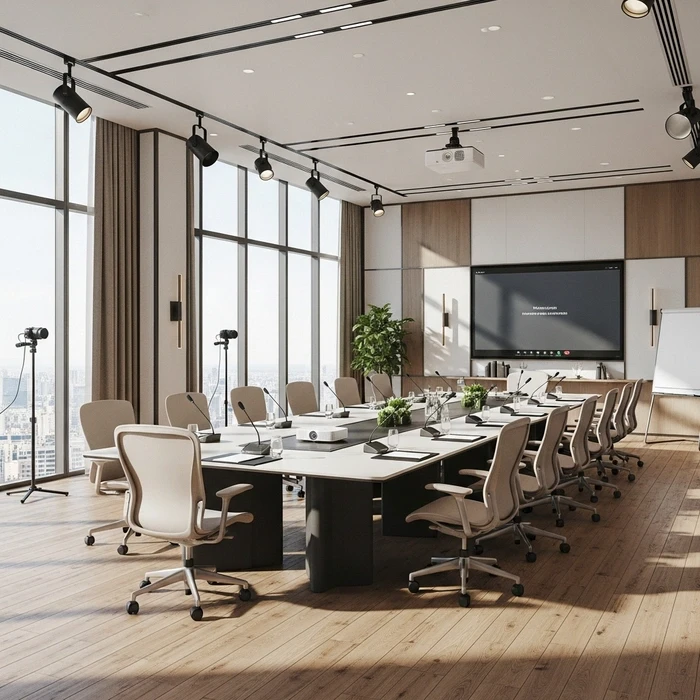
You booked a ballroom at the Conrad Abu Dhabi Etihad Towers. Your production crew confirmed the live stream rig. Speakers were briefed. Registration was open. Then 40% of your remote attendees dropped off within the first 15 minutes. The in-room audience had a seamless experience. The virtual side received a static wide-shot camera feed and a muted chat panel.
That gap is the single most expensive failure in hybrid corporate event planning today. And across the UAE, KSA, and Qatar, it happens at nearly every major corporate gathering that attempts a hybrid format without a proper operational framework.
This is not a beginner's overview. This is a technical, step-by-step playbook built from producing hybrid seminars, product launches, board meetings, and galas across the Gulf. Every section addresses a specific operational question. Every recommendation is grounded in what actually works in this region, in 2026, with the infrastructure and vendor landscape available right now.
If you are responsible for planning corporate events in the Middle East, this is the resource that closes the gap between intention and execution.
What Makes Hybrid Event Strategy Fundamentally Different in the Gulf?
Hybrid events in the Gulf demand a dual-production mindset where the virtual experience is designed as a standalone broadcast, not an afterthought streamed from a room camera. Regional factors like extreme time zone spread, venue AV variability, and cultural expectations for premium production quality make the Gulf a uniquely challenging hybrid environment.
The Dual-Production Mindset
Most corporate planners still treat the virtual component as a window into the physical room. That model fails. A genuine hybrid event strategy requires you to produce two parallel experiences with a shared content spine. The in-room audience gets spatial design, networking moments, and physical collateral. The virtual audience gets broadcast-quality video, interactive overlays, and a curated digital audience journey.
These are not two versions of the same event. They are two events that happen to share speakers, content, and a brand narrative.
Why the Gulf Amplifies the Complexity
Three regional realities make this harder here than in most global markets:
Infrastructure inconsistency. A five-star hotel in DIFC may have enterprise-grade fiber. A resort ballroom in Ras Al Khaimah may rely on bonded 4G. You cannot assume connectivity.
Cultural production expectations. Gulf-based C-suite audiences, especially in KSA and Qatar, expect premium staging. A hybrid setup that visibly deprioritizes either audience signals a lack of professionalism.
Time zone spread. A seminar in Dubai targeting attendees in London, Mumbai, and Singapore spans a 7-hour window. Your run of show must account for content pacing across those zones.
The Shift From "Event With a Stream" to "Hybrid-First Design"
The organizations leading in this space, from sovereign wealth funds in Abu Dhabi to tech firms scaling across NEOM, have shifted to a hybrid-first design model. That means the virtual attendee experience influences room layout, speaker staging, and even lighting design from day one.
This shift is not philosophical. It is operational. And it starts with understanding how to plan a hybrid corporate event from the ground up.
How Do You Plan a Hybrid Corporate Event From Scratch?
Start with audience segmentation, not logistics. Define who attends in-person versus virtually, what each group needs to achieve, and how success is measured for both segments before selecting a venue, a platform, or an AV partner.
Step 1: Define Your Audience Segments and Their Goals
Before you open a single vendor brief, answer these questions:
What percentage of your audience is attending in-person versus remotely?
Are remote attendees passive viewers or active participants?
Is the virtual component a real-time simulcast or an on-demand replay?
Do both audiences need networking access?
The answers shape every decision downstream. A product launch for 200 in-room guests and 2,000 virtual viewers requires a broadcast-grade production model. A board meeting for 15 in-room and 10 remote participants requires a high-fidelity video conferencing setup with document sharing.
Step 2: Select Your Venue Based on Hybrid Readiness
Not every premium venue supports hybrid well. You need dedicated power circuits for production equipment, hardwired internet with guaranteed upload speeds above 50 Mbps, and a room layout that allows camera angles without obstructing the in-room experience.
In Dubai, properties like the Madinat Jumeirah Conference Centre and the Hilton Dubai Al Habtoor City offer strong AV infrastructure. In Riyadh, the King Abdullah Financial District (KAFD) conference facilities have been built with hybrid capability in mind. In Doha, the Sheraton Grand Doha Resort remains a reliable option for mid-scale corporate events requiring dedicated production power.
Before confirming any venue, run through a proper AV readiness checklist for event venues to verify that the space can support your hybrid technical requirements.
Step 3: Build Your Core Planning Team
A hybrid event needs more roles than a traditional one. At minimum, you need:
An in-room event manager who owns the physical experience.
A virtual experience producer who owns the broadcast, platform, and remote audience engagement.
A technical director who bridges both, managing the AV partner, stream switching, and the run of show.
Splitting these roles prevents the most common failure: one team trying to manage two fundamentally different audience experiences simultaneously.
Step 4: Lock the Run of Show With Dual Timelines
Your run of show should have two parallel columns. One for the room. One for the stream. They share session start times and speaker slots. But they diverge on transitions, engagement prompts, and break timing.
For example, a 10-minute networking break in the room might be a curated poll or a pre-recorded behind-the-scenes segment for the virtual audience. Dead air on a live stream kills engagement faster than any content gap in a physical room.
Flaash Expert Insight: For hybrid events targeting audiences across the GCC, schedule your keynote between 10:00 and 11:30 AM Gulf Standard Time. This window catches European mornings and South Asian afternoons, maximizing live virtual attendance across your most common stakeholder time zones.
What Hybrid Event Technology Stack Do You Actually Need?
You need three core layers: a streaming and broadcast layer, an audience interaction layer, and a data and analytics layer. The most common mistake is over-investing in the streaming platform while under-investing in the engagement and measurement tools that determine ROI.
The Streaming and Broadcast Layer
This is your live video pipeline. It includes cameras, a video switcher, encoding hardware or software, and the content delivery network (CDN) that pushes the stream to your attendees.
For corporate events in the Gulf, the standard setup in 2026 includes:
Minimum two PTZ cameras plus one fixed wide shot.
A dedicated streaming encoder (hardware-based for reliability; software for smaller setups).
A CDN with Middle East edge servers. Latency matters. A 15-second delay frustrates remote attendees during live Q&A. Providers with regional nodes in the UAE and KSA reduce this significantly.
Your AV partner should own this layer end-to-end. If you are splitting camera operation and stream encoding between different vendors, you are introducing failure points.
The Audience Interaction Layer
This is where hybrid event engagement lives or dies. Your platform selection must support:
Live Q&A moderation with the ability to surface questions to in-room moderators and speakers.
Polling and surveys that aggregate results from both audiences in real time.
Chat functionality that allows virtual attendees to interact with each other, not just watch.
Breakout room capability for workshops or smaller group discussions.
Platforms like Hopin, Zuddl, and Airmeet have matured significantly for the Gulf market. Some now offer Arabic-language interfaces and regional compliance features relevant for KSA-based data hosting.
For a deeper dive into selecting and deploying the right engagement tools, review how leading teams integrate attendee engagement apps in corporate events.
The Data and Analytics Layer
Every hybrid event should generate structured data. This includes:
Registration conversion rates (registered versus attended, by audience type).
Session engagement scores (average watch time, poll participation, chat activity).
Content consumption patterns (which sessions had the highest virtual retention).
Lead scoring integration if the event is tied to a sales pipeline.
This layer is what transforms a hybrid event from a communication exercise into a measurable business asset. Without it, you cannot justify the hybrid event budget to senior leadership.
Hardware Versus Software: What to Own, What to Rent
For organizations running more than four hybrid events per year in the UAE, owning a core kit of PTZ cameras, a compact switcher, and encoding hardware starts to make financial sense. For less frequent producers, your AV partner should provide this as part of their production package.
Hybrid event technology is not a single platform purchase. It is a layered stack that must be tested, integrated, and rehearsed before every event.
How Do You Engage Both In-Person and Virtual Audiences Equally?
Design engagement touchpoints independently for each audience, then synchronize them at key moments. Forcing identical interaction formats on physically present and remote attendees creates friction for both groups. The most effective hybrid events treat engagement as two parallel tracks that converge during Q&A, polls, and shared reveals.
The Engagement Gap Is a Design Problem
Research from Harvard Business Review on what it takes to run a great hybrid meeting highlights that remote participants consistently feel like second-class attendees when the event is designed room-first. This finding holds even more strongly in high-production Gulf corporate events where the in-room experience is visually impressive.
The solution is not to diminish the room. It is to elevate the stream.
Engagement Tactics for the In-Room Audience
Spatial interaction zones. Dedicate areas for live demo stations, networking corners, and sponsor activations.
Audience response systems. Use in-room tablets or QR-code-based polling so in-room responses merge with virtual data.
Moderated panel seating. Arrange seating so audience members face both the stage and a visible screen showing the virtual audience feed. This visual cue reminds in-room attendees they are part of a larger event.
Engagement Tactics for the Remote Audience
Dedicated virtual host. A presenter who speaks directly to the camera, acknowledges chat activity, and bridges between sessions. This role is distinct from the stage MC.
Interactive overlays. Lower-third graphics showing poll results, attendee questions, and agenda navigation keep the stream dynamic.
Asynchronous content drops. Provide downloadable resources, exclusive interview clips, or early access to post-event materials as incentives for staying engaged.
Synchronization Points
The moments that feel most "hybrid" are when both audiences interact simultaneously. Design two to three of these per event:
Live Q&A with blended questions. The moderator alternates between in-room and virtual questions. Display the virtual attendee's name and location on screen.
Real-time polling with shared results. Both audiences vote. Results display on the room screen and the stream simultaneously.
Shared reveals. Product launches, campaign unveilings, or keynote announcements happen once, at the same moment, for everyone.
Q&A moderation is the most visible synchronization point. Get it right, and the event feels unified. Get it wrong, and virtual attendees disengage permanently.
Flaash Expert Insight: Assign a dedicated "virtual audience advocate" to sit in the production control room. Their only job is to monitor chat sentiment, flag technical issues on the stream, and feed questions to the stage moderator. This single role consistently improves virtual retention rates by 20% or more in our Gulf-based hybrid productions.
What Does a Hybrid Event Planning Checklist Look Like?
A comprehensive hybrid event planning checklist spans five phases: strategy, pre-production, rehearsal, live execution, and post-event. Each phase has distinct deliverables for both the physical and virtual experience, and skipping any phase, especially rehearsals, is the most reliable predictor of day-of failures.
Phase 1: Strategy (12–8 Weeks Out)
Define event objectives and KPIs for both audience segments.
Confirm audience size estimates (in-room and virtual).
Select venue based on hybrid readiness criteria.
Select virtual event platform.
Confirm hybrid event budget allocation across physical production, virtual production, and technology licensing.
Issue vendor RFPs for AV, streaming, and engagement technology.
For sourcing seminar and conference venues in the UAE with confirmed hybrid-ready infrastructure, start the venue selection process at least 10 weeks before your event date. Premium properties in Dubai and Abu Dhabi book fast during Q4.
Phase 2: Pre-Production (8–4 Weeks Out)
Finalize speaker management briefs. Every speaker must understand they are presenting to two audiences. Provide guidelines on camera awareness, slide legibility for small screens, and interaction cues.
Build the dual-column run of show.
Confirm all event registration flows. Virtual and in-person attendees may have different registration fields, confirmation emails, and pre-event communications.
Develop contingency planning documents. What happens if the stream drops? What happens if a speaker cannot attend in person and must present remotely? Document fallback protocols.
Begin content production for virtual-exclusive segments (pre-recorded interviews, animated intros, sponsor reels).
Phase 3: Rehearsal (3–1 Days Out)
Full technical rehearsal with all AV equipment, streaming infrastructure, and platform features live. Test every camera angle, every microphone, every slide transition.
Speaker rehearsal on the actual stage with the actual camera setup. Remote speakers rehearse via the actual platform connection.
Engagement tool rehearsal. Run a mock poll, a mock Q&A, and a mock breakout session to confirm everything integrates.
Contingency drill. Simulate a stream failure and execute your fallback protocol.
Skipping rehearsals is not a time-saving decision. It is a risk-acceptance decision. In the Gulf market, where corporate reputations are built on execution quality, that risk is rarely worth taking.
Phase 4: Live Execution (Event Day)
Production team arrives minimum 4 hours before doors open.
Run a 60-minute pre-show technical check after full setup.
Virtual platform opens 15–30 minutes before the first session with a holding screen or welcome loop.
Execute the run of show with real-time coordination between in-room event manager, virtual producer, and technical director.
Monitor virtual audience metrics live. If engagement drops below baseline, trigger pre-planned intervention (poll, host interaction, content shift).
Phase 5: Post-Event (1–14 Days After)
Distribute on-demand recordings to virtual attendees within 48 hours.
Compile post-event reporting across all data layers (attendance, engagement, content performance, lead data).
Conduct an internal debrief with all vendors and stakeholders.
Deliver executive summary with ROI analysis tied to original KPIs.
This hybrid event planning checklist is not a template you download and forget. It is an operational framework that must be adapted to each event's specific scale, objectives, and regional context.









How Do You Build a Hybrid Event Budget That Justifies the Investment?
Expect to allocate 30–40% of your total event budget to the virtual production layer, including streaming infrastructure, platform licensing, virtual engagement tools, and the additional production personnel required. Organizations that treat virtual as a marginal add-on consistently underinvest and underdeliver.
The Real Cost Structure of Hybrid Event Production
A common misconception is that hybrid simply means "the event budget plus a camera and a stream." The actual cost structure breaks down into three buckets:
Bucket 1: Physical Production (50–60% of budget)
This covers venue hire, staging, lighting, in-room AV, catering, printed materials, and on-site staffing. This is your traditional event budget.
Bucket 2: Virtual Production (30–40% of budget)
This covers streaming hardware and encoding, platform licensing fees, CDN costs, virtual-exclusive content production, remote speaker integration, a virtual host, and a dedicated virtual production team. This is the bucket most planners undersize.
Bucket 3: Integration and Data (5–10% of budget)
This covers engagement platform integration, registration system setup for dual audiences, analytics dashboards, and post-event data processing.
Where Gulf-Based Events See Cost Pressure
Three line items tend to surprise planners in this region:
Connectivity upgrades. If the venue's house internet cannot support your stream, you may need to bring in a dedicated fiber line or a bonded cellular solution. In some Riyadh and Doha venues, this can add $3,000–$8,000 to your budget.
Arabic-language platform customization. If your virtual audience includes Arabic-speaking attendees, platform localization, live translation overlays, and RTL interface adjustments carry additional licensing or development costs.
Extended production days. Venues in the UAE often charge by the day, and a proper hybrid setup requires at least one full day of load-in and technical rehearsal before the event day.
Justifying the Budget Internally
The strongest argument for hybrid event production investment is reach-per-dollar. A physical-only seminar for 150 attendees costs X. Adding a virtual layer for 500 additional attendees might increase the budget by 35%, but it increases your audience by over 300%. The cost-per-attendee drops dramatically.
Frame the hybrid event budget conversation around three metrics:
Cost per engaged attendee (total budget divided by attendees who met a minimum engagement threshold).
Pipeline value generated (for sales-driven events, tie registration and engagement data to CRM pipeline).
Content lifespan value (on-demand recordings extend the content's reach for weeks or months after the live event).
Flaash Expert Insight: When budgeting for hybrid events in KSA, factor in a 15–20% contingency specifically for last-minute AV and connectivity adjustments. Venue technical specifications in newer Riyadh developments like KAFD are reliable, but older properties frequently require on-site upgrades that are only discovered during load-in.
What Hybrid Event Best Practices Separate Good From Exceptional?
The difference between a competent hybrid event and an exceptional one lies in three areas: speaker preparation for dual audiences, obsessive rehearsal culture, and treating the virtual attendee journey as a standalone product. Most failures are not technical. They are preparation failures.
Best Practice 1: Speaker Preparation Is Non-Negotiable
Every speaker at a hybrid event is performing for two audiences simultaneously. This requires specific coaching:
Camera awareness. Speakers must periodically look directly into the front-facing camera, not just at the room audience. This creates a sense of connection for virtual viewers.
Slide design for small screens. Fonts below 24pt become unreadable on a laptop stream window. Limit text per slide. Use high-contrast visuals.
Interaction cues. Speakers should verbally acknowledge the virtual audience. Simple phrases like "For those joining us online, I'd love to see your questions in the chat" bridge the gap.
Speaker management for hybrid events takes twice the preparation time of a physical-only event. Budget your pre-event schedule accordingly.
Best Practice 2: Rehearse Like a Broadcast
Television producers do not go live without a full rehearsal. Neither should you. Every hybrid event best practices guide will tell you this, but the execution rate in the Gulf market remains low. Teams cite time pressure, speaker availability, and venue access as barriers.
Overcome them:
Book the venue for a full rehearsal day. Yes, this costs more. The ROI is avoiding a public failure.
If speakers cannot attend in person, conduct a 30-minute virtual rehearsal on the actual platform with the actual production team.
Rehearse transitions between sessions. The moments between speakers are where virtual streams most often break down (dead air, wrong camera, muted microphones).
Best Practice 3: Design the Virtual Attendee Journey as a Product
Map the virtual audience journey from registration to post-event follow-up:
Pre-event: Personalized confirmation emails, calendar holds with platform access links, pre-event content teasers.
Event day: A polished holding screen, a welcome from the virtual host, clear navigation within the platform, and real-time support for technical issues.
Post-event: On-demand access within 48 hours, personalized follow-up based on session attendance, and a feedback survey tailored to the virtual experience.
This journey should feel as intentional and curated as walking into a beautifully staged ballroom at the Atlantis The Royal in Dubai. The medium is different. The standard of care should not be.
Best Practice 4: Contingency Planning Is a Core Deliverable
Contingency planning is not a slide at the back of your production deck. It is a rehearsed set of protocols:
Stream failure protocol. Who switches to the backup encoder? How is the virtual audience notified? Is there a pre-recorded holding segment ready to deploy?
Speaker no-show protocol. Can a remote speaker fill the slot via the platform? Is there a pre-recorded version of the presentation available?
Platform outage protocol. Do you have a secondary streaming destination (e.g., a private YouTube Live link) ready to activate?
Document these. Rehearse them. Assign specific people to execute each one.
Best Practice 5: Close the Loop With Post-Event Reporting
Post-event reporting is where hybrid events demonstrate their strategic value. Combine physical attendance data with virtual engagement analytics to produce a unified event performance report.
Key metrics to include:
Total reach (in-room plus virtual).
Engagement rate by audience type.
Session-level retention curves for the virtual audience.
Lead quality scores if integrated with CRM.
Net Promoter Score from post-event surveys segmented by attendance type.
This report is not just for your records. It is the document that secures budget approval for your next hybrid event.
The Bottom Line for UAE Corporate Events
Hybrid corporate event planning in the Middle East is no longer experimental. It is the operating standard for organizations that need to reach distributed stakeholders without sacrificing production quality or engagement depth.
The playbook is clear. Segment your audiences. Design two parallel experiences. Invest properly in the virtual production layer. Rehearse relentlessly. Measure everything.
The organizations that execute this well, across UAE corporate events, KSA summits, and Qatar conferences, are the ones converting single events into sustained audience relationships.
If you are planning your next hybrid corporate event in the Gulf and need a venue, a technology stack, or a production partner that understands this model, start with the infrastructure. Everything else follows from there.
Flaash sources and supports hybrid-ready venues across the UAE, KSA, and Qatar. Talk to our team before your next RFP goes out.
FAQ: hybrid corporate event planning
What is hybrid corporate event planning?
A hybrid corporate event combines in-person and virtual attendance into one coordinated experience, using live streaming and interactive tools so remote and onsite participants can engage in real time.
What are the main benefits of hybrid corporate events?
Hybrid events expand reach, reduce travel costs, increase attendance flexibility, and provide richer engagement data from both virtual and physical audiences.
What technology do I need for hybrid corporate event planning?
Key technology includes professional cameras and microphones, streaming software or platform, reliable high‑speed internet, an engagement tool for polls/Q&A, and a production switcher or AV team to manage feeds.
How do I choose a venue for a hybrid corporate event?
Select a venue with high-bandwidth internet, built-in AV or vendor support, space for a production area, good acoustics, and dedicated technical staff experienced with live streaming.
How much does hybrid corporate event planning cost?
Costs vary widely, but expect 20–40% higher production costs versus an in-person event due to streaming, AV rental, and additional staffing—offset by savings on travel and increased virtual attendance.
How can I keep virtual attendees engaged during a hybrid event?
Use live polls, moderated Q&A, breakout rooms, virtual networking lounges, and a dedicated virtual host who addresses online attendees directly to maintain engagement.
Recent Posts


Load More Blogs