
-
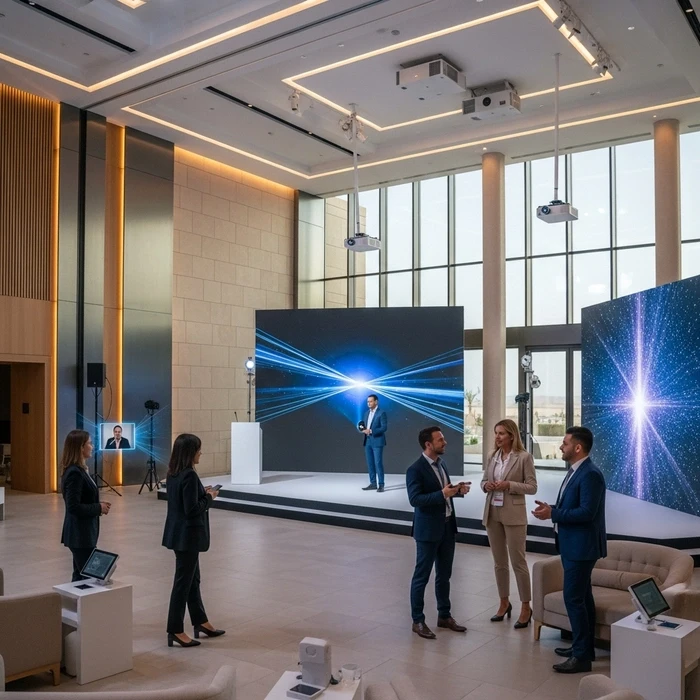
Most corporate event planners in the Gulf are stuck in a false binary. They treat hybrid as either a livestream bolted onto a physical event or an expensive experiment that leadership barely tolerates. Neither framing reflects reality in 2026.
The region has moved past the question of whether hybrid works. The real conversation now centers on how to execute it with precision. Between the Dubai and Abu Dhabi market scaling infrastructure at speed, Saudi and GCC expansion rewriting what corporate hospitality looks like, and Qatar refining a distinct premium model, the Middle East is not copying global hybrid playbooks. It is writing its own.
This piece is built for the planner, the comms director, or the HR lead who needs to make a business case for hybrid. Not hype. Not theory. A grounded look at where hybrid corporate events Middle East are heading, what production actually demands on the ground, and where budgets should go. If you are responsible for corporate seminars, product launches, board-level summits, or investor galas in this part of the world, this is the operational lens you need.
The future of hybrid corporate events in the Middle East will not be shaped by flashy technology alone. It will be shaped by smart decisions about venues, audience design, data strategy, and cultural context.
What Does the Future of Hybrid Corporate Events in the Middle East Really Look Like?
Hybrid in the Middle East is evolving into a structured, dual-audience format where in-person and remote experiences are designed separately but orchestrated together. The region's investment in infrastructure, connectivity, and corporate tourism is accelerating this shift faster than most global markets.
The Post-Pandemic Reset Is Over
The early hybrid era was reactive. Companies streamed content because they had to. By 2026, the reactive phase is done. Corporate teams across the Gulf now evaluate hybrid on its strategic merit, not as a fallback.
What changed is expectation. C-suite decision-makers in Riyadh, Dubai, and Doha now expect a hybrid option as standard for any event exceeding fifty attendees. It is not a perk. It is a procurement requirement.
What Hybrid Means in 2026
The term itself has matured. A hybrid event in 2026 is not a conference with a camera in the back of the room. It is a deliberately designed experience for an in-person and virtual audience, with distinct content tracks, engagement loops, and measurement layers for each.
This includes simulive sessions pre-recorded for quality and aired with live interaction windows. It includes on-demand libraries published within hours. It includes two-way interaction between physical and remote audiences during Q&A segments. The bar has risen. Your virtual attendees know when they are an afterthought.
Why the Middle East Is Leading, Not Following
Three structural advantages set this region apart. First, government-backed investment in digital infrastructure across UAE, KSA, and Qatar ensures reliable high-bandwidth connectivity at most major event venues. Second, the corporate event market here is overwhelmingly B2B and government-adjacent, which means budgets are larger and expectations are higher. Third, the region's position between European and Asian time zones makes it a natural hub for hybrid events that need to reach global audiences without punishing scheduling.
The Middle East event industry trends are clear. Hybrid is not a format. It is becoming the default operating model for serious corporate gatherings.









How Is Corporate Event Technology Reshaping Hybrid Formats Across the Region?
Corporate event technology in the Middle East is moving toward integrated ecosystems that connect virtual platforms, event apps, production hardware, and data dashboards into a single workflow. Standalone tools are being replaced by unified stacks that serve both audiences simultaneously.
Virtual Platforms Are Maturing Fast
The days of clunky webinar tools masquerading as event platforms are fading. In 2026, most corporate planners in the Gulf are working with virtual platform providers that offer branded environments, breakout rooms, sponsor integrations, and real-time analytics.
Platforms now support Arabic and English interfaces natively, which matters in a bilingual corporate environment. The strongest setups allow remote attendees to navigate between sessions, visit virtual exhibition stands, and book one-to-one meetings, all within a single login experience.
For planners building their first integrated setup, understanding the full hybrid event technology stack is essential before vendor conversations begin.
Broadcast-Quality Production Is the New Baseline
Here is a hard truth. If your hybrid event looks like a Zoom call on a big screen, you have already lost your remote audience. Broadcast-quality production is no longer optional for corporate events in the Gulf.
This means multi-camera setups, professional lighting rigs, dedicated audio mixing for the stream, and real-time graphics overlays. Hotels like the Atlantis The Royal in Dubai, the St. Regis Saadiyat Island in Abu Dhabi, and The Ritz-Carlton in Riyadh now offer in-house AV partnerships designed specifically for hybrid broadcasts.
Corporate event technology Middle East budgets should allocate a minimum of twenty to thirty percent of total spend to production. Anything less, and you risk undermining the credibility of the entire event for your virtual tier.
The Role of Event Apps in Bridging Two Audiences
A well-designed event app serves as the connective tissue between physical and digital audiences. It is the single interface where both groups access schedules, speaker bios, live polls, networking features, and post-event content.
The best implementations in the region tie the app directly into badge scanning and lead tracking systems. This creates a unified data layer. Whether someone attended in person in Doha or joined remotely from Jeddah, their engagement data flows into the same CRM pipeline.
Flaash Expert Insight: When evaluating event apps for GCC hybrid events, prioritize platforms with native Arabic support and offline functionality. Connectivity in newer Saudi venues outside Riyadh can be inconsistent during peak event periods.
What Should Planners Know About Hybrid Event Production Across UAE, Saudi Arabia, and Qatar?
Hybrid event production varies significantly across UAE, Saudi Arabia, and Qatar due to differences in venue maturity, AV vendor ecosystems, and local regulatory environments. Planners must adapt their production model to each market rather than applying a single regional template.
Dubai and Abu Dhabi: Infrastructure Advantage
The UAE remains the most mature hybrid event market in the Gulf. Dubai's Madinat Jumeirah, DWTC venues, and properties along Sheikh Zayed Road offer built-in fiber connectivity, rigging points for broadcast lighting, and experienced in-house technical teams.
Abu Dhabi's Saadiyat Island and Yas Island properties are catching up quickly. The Louvre Abu Dhabi and Erth Abu Dhabi Hotel have hosted high-profile hybrid events UAE with global broadcast components. The advantage here is vendor density. You can source production crews, streaming partners, and on-site technical directors within a single emirate.
Saudi Arabia's Rapid Expansion in Event Infrastructure
The Saudi market is the most dynamic story in the region right now. Riyadh's King Abdullah Financial District (KAFD) is emerging as a premier hub for corporate events. Jeddah's waterfront developments and NEOM-adjacent venues are creating entirely new options.
However, the vendor ecosystem is still scaling. Planners should expect to bring production partners from Dubai for high-complexity hybrid setups, particularly for events requiring simultaneous Arabic and English broadcast streams. Lead times are longer. Permitting for certain production elements requires more advance coordination than in the UAE.
Hybrid event production in Saudi Arabia is improving quarter by quarter. But it rewards the planner who starts early and builds local relationships.
Qatar's Boutique Approach to Corporate Hosting
Qatar occupies a distinct niche. Post-2022 World Cup infrastructure means the country has world-class venues, but the corporate event market is smaller and more curated. Properties like the Mondrian Doha, Raffles Doha, and the Qatar National Convention Centre offer excellent hybrid-ready facilities.
The Doha market tends to attract government-linked summits, financial sector gatherings, and energy industry events. For these formats, production expectations are extremely high. Planners should budget accordingly and engage Doha-based AV partners early.
Flaash Expert Insight: Booking venues in Qatar during Q4 requires at least a six-month lead time. The overlap with National Day celebrations and year-end government summits compresses availability significantly.
Venue Sourcing Complexity
One of the most underestimated challenges in hybrid event production is finding the right venue. Not every five-star ballroom is hybrid-ready. You need dedicated control rooms, sufficient power supply for broadcast equipment, acoustically treated spaces, and separate green rooms for speakers managing both live and virtual appearances.
This is where working with a venue sourcing partner adds real operational value. Flaash.ae helps companies find and book corporate event venues across the Middle East for free. You submit a brief online, and a project manager replies within 24 to 48 hours with three to five tailored turnkey venue proposals and detailed quotes across more than 8,000 venues in cities like Dubai, Abu Dhabi, Riyadh, Jeddah, Doha, and Dammam. The service supports corporate events only and removes the guesswork from sourcing hybrid-capable spaces.
If you are still shaping your planning approach, this guide to hybrid corporate event planning is a useful companion, especially when venue decisions need to align with production and attendee flow from the start.
How Do You Design a Meaningful Audience Experience for Both In-Person and Virtual Attendees?
Successful audience experience design starts by treating in-person and virtual as two distinct event products that share a common narrative. Each audience requires its own engagement mechanics, pacing, and content delivery approach to feel valued rather than sidelined.
Stop Treating Virtual as a Livestream Add-On
This is the single biggest mistake planners make in the region. If your virtual experience is a passive stream of the main stage, your remote attendees will disengage within twenty minutes. The data on this is consistent across every major platform provider.
Audience experience design for virtual attendees means dedicated hosts who speak directly to the camera. It means exclusive virtual-only breakout sessions. It means interactive elements like live polling, moderated chat, and real-time Q&A that give remote participants a voice in the room.
Harvard Business Review published an analysis of what it takes to run effective hybrid meetings that remains relevant. The core principle holds. Design for the remote experience first, then layer in the physical.
Speaker Management for Dual Audiences
Speaker management in a hybrid context is fundamentally different from a traditional stage brief. Speakers need coaching on how to address a camera while engaging a live audience. Eye contact, pacing, and slide design all change when half your audience is watching on a screen.
The strongest hybrid events in the Gulf now assign a dedicated virtual producer to each speaker. This person manages the remote audience's experience in real time, feeding questions to the speaker, adjusting camera angles, and triggering graphics overlays. It is an additional role that most planners overlook. Do not.
Networking Formats That Cross the Screen
Networking formats are the hardest element to get right in hybrid. Physical attendees network naturally over coffee. Virtual attendees need structure.
The formats gaining traction in the Gulf include AI-matched one-to-one video meetings, virtual roundtable discussions capped at eight participants, and hybrid ask the expert lounges where a physical room is connected to a virtual breakout. For practical ideas that work specifically for remote participants, this guide on remote attendee engagement is a solid starting point.
Content Repurposing as a Strategic Asset
Content repurposing is where hybrid pays for itself long after the event ends. Every session recorded in broadcast quality becomes a marketing asset. Keynote clips become LinkedIn content. Panel discussions become podcast episodes. Workshop recordings become gated lead magnets.
The best corporate teams in the region now plan their content calendar around their event calendar. A single hybrid summit in Dubai can generate three months of owned media. That is the ROI argument that gets CFO buy-in.
What Hybrid Event Engagement Strategies Actually Work in the GCC?
The most effective hybrid event engagement strategies in the GCC prioritize two-way interaction, cultural relevance, and measurable participation over flashy technology gimmicks. What works here is not always what works in London or Singapore.
Two-Way Interaction Over Passive Viewing
Passive content consumption is the enemy of engagement. The formats that perform best in the Gulf market are those that demand participation. Live polling with results displayed on screen. Audience-submitted questions voted on in real time. Two-way interaction between a moderator in the room and a virtual co-host managing the stream.
The key insight is that GCC corporate audiences are highly engaged when they feel their input shapes the conversation. This is culturally rooted. Majlis-style dialogue, where voices are heard in turn, translates surprisingly well into structured hybrid Q&A formats.
Simulive Sessions Done Right
Simulive is one of the most underused tools in the hybrid planner's kit. A simulive session is pre-recorded for production quality but broadcast at a scheduled time with a live chat and Q&A layer running alongside it.
This format solves two problems. It eliminates the risk of technical failures during live presentations. And it allows speakers who cannot attend in person to deliver polished content while still engaging with the audience in real time via chat.
For product launches and investor briefings in the region, simulive is becoming the preferred format. The production value is higher. The speaker can approve their final cut. And the audience still gets a live interaction window.
Cultural Nuance in Engagement Design
A detail that global agencies often miss is that engagement norms differ between UAE, Saudi, and Qatari corporate audiences. UAE audiences, particularly in Dubai, are accustomed to fast-paced, globally styled event formats. Saudi audiences, especially in government-adjacent events, often prefer more formal structures with designated question periods. Qatari corporate events tend toward smaller, high-touch formats where relationship depth matters more than audience scale.
Your hybrid event engagement strategy must flex to these norms. A one-size-fits-all approach will underperform.
Flaash Expert Insight: For hybrid product launches targeting Saudi government stakeholders, allocate at least thirty minutes of structured Q&A per ninety-minute session. The engagement rate on these segments consistently outperforms other formats in the KSA market.
How Should You Approach Data Capture, ROI, and Privacy Compliance at Hybrid Events?
Hybrid events generate richer data than any single-format event, but planners must build their data architecture before the event to capture, unify, and act on insights across both physical and virtual channels while respecting regional privacy regulations.
Lead Tracking Across Two Channels
The commercial value of a hybrid event lives in its data. Data capture from physical attendees through badge scans, session check-ins, and app interactions must merge with virtual attendee data from platform logins, content views, and chat participation.
The planners who get this right build a unified attendee profile before the event. Every touchpoint, whether a booth visit in Abu Dhabi or a webinar click from Dammam, feeds into one record. This is what transforms an event from a cost center into a pipeline accelerator.
Lead tracking must be planned at the brief stage, not retrofitted after the event. Your technology stack, from event app to virtual platform to CRM, needs to be integrated before a single invitation is sent.
For those building KPI frameworks from scratch, this resource on hybrid event KPIs offers a practical starting model for measurement.
Privacy Compliance in a Multi-Jurisdiction Region
Privacy compliance is a growing concern that too many event teams in the Gulf still treat as an afterthought. The UAE's Federal Decree-Law on Data Protection, Saudi Arabia's Personal Data Protection Law, and Qatar's National Privacy Framework each impose specific requirements on how attendee data is collected, stored, and processed.
For hybrid events that capture data across borders, you need clear consent mechanisms on both the physical registration desk and the virtual platform. Cookie banners are not enough. You need documented data processing agreements with every vendor in your stack.
This is not optional. It is a legal and reputational risk that can derail an otherwise successful event.
Measuring What Matters
Not everything that can be measured should be. The metrics that matter for hybrid event strategy in the Gulf are attendance-to-engagement ratio, content completion rates for virtual sessions, post-event pipeline attribution, and net promoter scores segmented by audience type.
Vanity metrics like total registrations or page views tell you very little. The question is not how many people showed up. The question is how many people did something meaningful after the event because of their experience during it.
Hybrid event trends 2026 are pointing toward real-time dashboards that let planners adjust content, pacing, and engagement tactics mid-event based on live data. This operational agility is the next competitive edge.
For companies planning a regional summit, conference, or leadership event, it also helps to review a practical framework for how to host a hybrid conference in the UAE, because many of the operational lessons apply across the wider Gulf.
What Regional Differences Between UAE, Saudi Arabia, and Qatar Will Shape the Next Three Years?
The three largest GCC corporate event markets are diverging in pace, scale, and strategic focus, requiring planners to develop distinct hybrid approaches for each country rather than treating the region as a monolithic market.
UAE: The Mature Market
The UAE, particularly Dubai, remains the benchmark for hybrid events UAE execution. The vendor ecosystem is deep. Venue options are extensive. Client expectations are sophisticated.
The challenge in the UAE is differentiation. With so many hybrid events competing for attention, the bar for production quality, audience experience, and content originality is exceptionally high. Cookie-cutter hybrid formats will not cut through.
Abu Dhabi is emerging as a strong alternative for corporate clients seeking a quieter, more premium setting. Government entities in the capital are increasingly hosting hybrid policy forums and economic summits that draw global audiences.
Saudi Arabia: Scale and Ambition
Saudi Arabia is the growth story. Vision 2030 is creating an entirely new tier of corporate event demand. Riyadh, Jeddah, and the Eastern Province are all expanding their capacity for large-scale hybrid corporate gatherings.
The Saudi and GCC expansion trajectory means more venues, more AV providers, and more sophisticated client requirements every quarter. Planners who build relationships in the Saudi market now will have a significant advantage over the next three years.
The key operational consideration is lead time. Everything in Saudi Arabia takes longer to arrange than in the UAE. Permits, venue access, production logistics, and government approvals all require additional runway. Plan for it.
Qatar: Quality Over Volume
Qatar's corporate event market is smaller but highly concentrated. The clients here tend to be sovereign wealth funds, energy majors, and international financial institutions. They expect flawless execution.
For hybrid events in Doha, production standards must be at broadcast level from the first frame. The margin for error is slim. But the commercial value per attendee is often significantly higher than in larger markets.
The practical takeaway is that Qatar rewards depth over breadth. A smaller, beautifully produced hybrid summit in Doha can generate more business impact than a larger, loosely executed conference elsewhere.
What Will Realistically Define Winning Hybrid Event Strategy in the Middle East?
The next few years will reward discipline more than novelty. The strongest hybrid event strategy will not be the one with the most tools. It will be the one that makes the clearest choices.
First, companies will need to decide whether hybrid is being used for reach, stakeholder inclusion, lead generation, thought leadership, or internal alignment. These goals sound similar, but they require different formats. A leadership town hall needs a different structure from an external-facing summit. A product launch needs a different production rhythm from an investor forum.
Second, planners will need to build venue and technology choices around the audience, not the other way around. A beautifully branded virtual platform cannot compensate for weak sound in the ballroom. A premium venue cannot rescue an event with no interaction design for remote guests.
Third, teams will need to become more selective with agenda design. Hybrid events in the Middle East are likely to become shorter, tighter, and more editorial. Fewer sessions. Better moderation. Stronger speaker prep. More deliberate content repurposing. More moments designed specifically for participation rather than observation.
Finally, hybrid will become less of a special format and more of a standard planning mindset. The most effective teams will simply assume that every important corporate event has at least two audiences and should create value for both.
Conclusion
The future of hybrid corporate events in the Middle East is not a question of technology adoption. The technology is here. It is a question of strategic design. The planners who will lead this market over the next three years are those who treat hybrid as a dual-audience discipline, invest in production quality, build compliant data architectures, and adapt their approach to the distinct realities of UAE, Saudi Arabia, and Qatar.
This region does not lack ambition or infrastructure. What it needs is more planners who refuse to treat the virtual audience as secondary. Build for both audiences with equal intent, and your events will outperform in every metric that matters.
FAQ: future of hybrid corporate events in the middle east
What is the future of hybrid corporate events in the Middle East?
Hybrid corporate events will become the default model across the Middle East, with UAE, Saudi Arabia, and Qatar investing in integrated venue tech and connectivity to combine in-person networking with scalable virtual participation and regional reach.
Why are hybrid corporate events growing in popularity in the UAE, Saudi Arabia, and Qatar?
Organisations favour hybrid formats for wider audience access, lower travel costs, and improved ROI—benefits amplified by regional economic diversification such as Saudi Vision 2030, Dubai’s events agenda, and Qatar’s conference investment.
What corporate event technologies are essential for successful hybrid events in the region?
Critical tech includes high-bandwidth connectivity, professional AV and LED staging, integrated streaming platforms, real-time translation or closed captions, AI-driven engagement tools, and analytics for measuring ROI.
How should companies plan hybrid corporate events in the Middle East to maximise ROI?
Plan by choosing a venue with proven streaming and production capabilities, defining KPIs, localising content for MENA audiences, scheduling for time zones, securing sponsors where relevant, and repurposing recordings for ongoing value.
Are venues in the UAE, Saudi Arabia, and Qatar ready for hybrid corporate events?
Many major venues in Dubai, Riyadh, and Doha now offer built-in hybrid infrastructure, but organisers should verify SLAs, on-site production teams, redundancy, and local regulatory requirements before booking.
How can organisers keep both on-site and virtual audiences engaged during hybrid events?
Use interactive features like live polls, Q&A, breakout networking lounges, gamification, localised content, simultaneous interpretation, staggered schedules, and real-time analytics to improve engagement for both audiences.
Recent Posts


Load More Blogs