
-
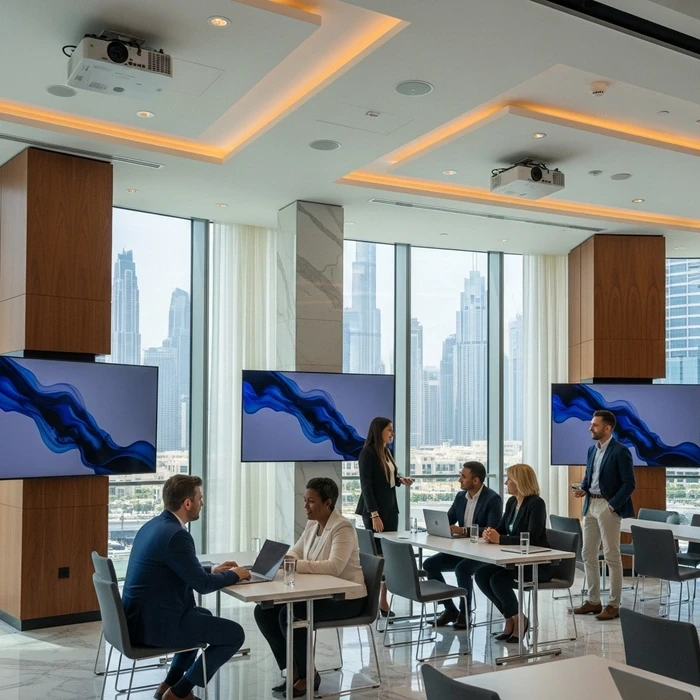
Your keynote speaker is live in Dubai. Three hundred attendees sit in the ballroom. Eight hundred more stream from Riyadh, London, and Singapore. One audio dropout, and you lose credibility with all of them at once. That is the operational reality of hybrid event production UAE teams navigate every week.
This UAE corporate event planning guide breaks down exactly how to host a hybrid conference in the UAE, from venue AV audits to post-event reporting. Consider it your UAE hybrid event checklist built for 2026.
What Makes the UAE the Strategic Choice for a Hybrid Corporate Conference?
The UAE combines world-class venue infrastructure, a central GMT+4 time zone, and government-backed digital connectivity, making it the strongest hybrid corporate conference UAE base in the Middle East.
Time Zone Advantage for Global Audiences
Time zone scheduling is a structural advantage. A 10:00 AM start in Dubai overlaps morning hours in Europe and late afternoon in East Asia. That single fact maximizes live virtual attendance across every major corporate market.
Digital Infrastructure and Regulatory Support
The UAE's Telecommunications and Digital Government Regulatory Authority enforces high broadband standards across commercial districts. Business hubs like DIFC, Abu Dhabi Global Market, and DWTC offer redundant internet as standard. For international delegates, the UAE's streamlined visa and Emirates ID services reduce entry friction significantly.
Venues Built for Broadcast
Hotels like Conrad Abu Dhabi Etihad Towers, Atlantis The Royal, and Ritz-Carlton DIFC now feature built-in fiber runs, dedicated AV control rooms, and broadcast-grade lighting rigs. These are selling points, not afterthoughts.
What Does a Realistic Hybrid Conference Planning Timeline Look Like?
A well-executed hybrid conference planning timeline requires a minimum of 14 weeks, with venue and platform decisions locked by week four and a full technical rehearsal completed 72 hours before the event.
Weeks 1 to 4: Strategic Foundations
Lock objectives, audience segmentation, and budget split. Select your venue based on an AV readiness audit, not aesthetics alone. Choose your hybrid event platform for conferences based on interactivity features, not just streaming quality.
Weeks 5 to 10: Production Build
Finalize the camera plan, lighting for broadcast, and stage management layout. Begin speaker briefing sessions, especially for remote presenters who need coaching on framing and audio delivery.
Weeks 11 to 14: Rehearse and Execute
Run a full technical rehearsal mirroring the live show. Test livestream encoding, RTMP stream stability, and audio mix-minus configurations. Confirm on-site registration workflows and virtual check-in systems simultaneously.
Flaash Expert Insight: In Dubai, Q1 and Q4 are peak conference seasons. Venue holds expire fast. Secure your shortlist by week two during these windows to keep your Dubai hybrid conference planning on schedule.
What AV and Technical Infrastructure Does a Hybrid Conference Require?
Hybrid conferences demand broadcast-grade AV, not ballroom AV. The AV requirements for hybrid conferences include redundant internet, hardware encoders, mix-minus audio, and a multi-camera plan built for remote viewers.
Non-Negotiable Technical Baseline
At minimum, plan for:
Two dedicated internet lines (primary fiber plus 5G failover), 50 Mbps upload combined
Hardware encoders for livestream encoding (software encoding adds unacceptable latency)
Audio mix-minus to prevent echo loops during remote Q&A
Three-camera setup: wide shot, presenter close-up, and content/slides
Lighting That Serves Two Audiences
Ballroom lighting flatters the room. Lighting for broadcast flatters the camera. These are different disciplines. Your production team must rig key and fill lights that maintain consistent color temperature on camera, independent of house lighting.
Flaash Expert Insight: Always request a site visit with your AV partner before signing. Many UAE hotel ballrooms have fixed chandeliers that create harsh on-camera shadows. Identifying this early saves thousands in corrective rigging.









How Do You Design the Virtual Attendee Experience to Match the Room?
The virtual attendee experience must be designed as its own production track with a dedicated director, moderation team, and interactive tools. It is not a passive camera feed of the ballroom.
Dedicated Virtual Production Track
Assign a virtual show director who manages the remote broadcast independently. They call camera switches, manage lower thirds, and cue virtual-only content like polls and breakout rooms. The experience degrades the moment it becomes a secondary concern.
Q&A Moderation Across Both Audiences
Q&A moderation requires a dedicated moderator bridging in-room and virtual audiences. Use a unified feed where remote questions appear alongside room questions. Prioritize them equally. Nothing alienates a virtual attendee faster than being ignored during a live panel.
For structuring the live flow, review this breakdown of hybrid event run of show best practices.
What Should Your Run of Show Cover on Event Day?
Your run of show must be a minute-by-minute document covering both in-room and virtual production tracks, including cue points, backup protocols, and crew assignments for every transition.
Building the Dual-Track Document
A hybrid run of show includes:
Exact cue times for camera switches, slide advances, and video playback
Crew assignments for stage management (in-room) and virtual switching (broadcast)
Backup scripts for internet failure, speaker no-shows, and platform outages
Pre-roll and post-roll content for the virtual stream
Post-Event Reporting That Proves ROI
Post-event reporting must unify both audience datasets. Track in-room badge scans alongside virtual watch time, poll participation, and replay views. UFI's global exhibition research confirms that hybrid events measuring both channels consistently report higher sponsor satisfaction.
Flaash Expert Insight: Build your post-event report template before the event. What you need to measure dictates what you capture, and that shapes your entire hybrid event technology stack.
How Do You Choose the Right Venue and Production Partner?
Select a venue with proven hybrid infrastructure and a production partner who executes broadcast-grade events in the UAE. Technical capability must outweigh aesthetics in your scoring criteria.
Venue Scoring Criteria
Evaluate on dedicated fiber connectivity, AV control room access, rigging points for broadcast lighting, and isolated power circuits. Properties across DWTC and Abu Dhabi's Saadiyat Island cluster consistently score highest. Whether you are focused on Abu Dhabi hybrid event planning or Dubai hybrid conference planning, infrastructure readiness is the deciding factor.
Why Partner Selection Outweighs Venue Selection
The best venue underperforms with the wrong production team. Your partner should own the stack end-to-end: encoding, streaming, switching, and on-site AV. Fragmented vendor chains create communication gaps that surface live, on camera, in front of your leadership.
Hybrid is not an add-on. It is the operating standard for serious corporate conferences in the UAE. The organizations treating it as a full production discipline are the ones filling both their ballrooms and their virtual lobbies. If your next conference needs to perform at that level, start with the right venue shortlist.
FAQ: how to host a hybrid conference in the UAE
What is a hybrid conference and how does it work in the UAE?
A hybrid conference combines an in‑person event with a live virtual component so attendees can join on-site or online. In the UAE this typically uses local venues with high-speed connectivity and in‑house AV, plus a virtual event platform for streaming, Q&A, polling and networking.
What are the first steps to plan a hybrid conference in the UAE?
Start with objectives, budget, target audience (local vs. international), preferred emirate and an approximate headcount for both onsite and virtual. Then shortlist venues, decide technology requirements and check local permit and visa needs early.
Which permits and local approvals are required?
You’ll usually need event/venue permits and commercial approvals from the relevant emirate authority (e.g., Dubai Department of Economy & Tourism, Abu Dhabi Department of Culture & Tourism); requirements vary by emirate and venue. Apply several weeks in advance and confirm any special approvals for filming, sponsors or large public attendance.
What venue features are essential for a hybrid event in the UAE?
Look for dedicated hybrid-capable rooms, reliable enterprise internet, on‑site production facilities, clear sightlines for cameras, power redundancy and separate spaces for virtual production and speaker green rooms. Major venues with hybrid infrastructure include Dubai World Trade Centre, ADNEC (Abu Dhabi) and Sharjah Expo — but always confirm bandwidth and in-house AV specs.
What technology stack do I need to stream reliably from the UAE?
Core components: professional cameras, mixing/encoding hardware, a robust uplink, a virtual event platform (for registration/engagement), on-site and remote moderators, and backup streaming routes. Reserve at least 5–10 Mbps uplink per HD stream as a baseline; for multiple concurrent streams or 4K/large audiences plan for substantially higher dedicated uplink (discuss exact figures with venue/ISP).
How do I keep virtual attendees engaged?
Use live Q&A, moderated chat, real-time polls, short interactive sessions, virtual networking rooms, and on-demand session playback. Appoint dedicated virtual moderators and schedule engagement moments specifically for online participants.
Recent Posts

Load More Blogs