
-
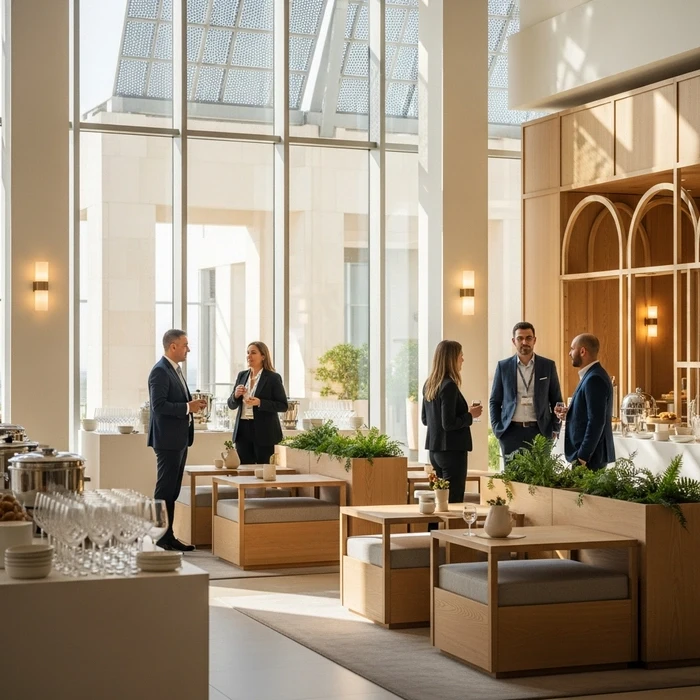
Most corporate event teams in the Gulf already know sustainability matters. The harder question is where to start when your CFO wants proof, your procurement team demands compliant suppliers, and your CEO expects the event to still feel premium.
In 2026, the GCC sustainability landscape has shifted from aspiration to accountability. Saudi Arabia's Vision 2030 milestones are being audited. The UAE Net Zero 2050 strategy now influences municipal permitting. Qatar's National Environment and Climate Change Strategy is shaping venue operations across Doha. For corporate planners, office managers, and HR/comms teams, this means every product launch, board meeting, gala, or seminar you organize carries a measurable environmental footprint. Stakeholders expect you to manage it.
This guide breaks down what sustainable corporate events GCC 2026 actually require: from venue selection and procurement to catering, waste, transport, energy, and the KPIs that matter in post-event reporting.
How Have Event Sustainability Trends Shifted in the GCC by 2026?
Corporate sustainability expectations in the GCC have moved from voluntary pledges to regulated, measurable requirements. Government frameworks in the UAE, Saudi Arabia, and Qatar now directly influence how companies plan and report on events, making greenwashing a reputational and compliance risk.
National Strategies Are Setting the Pace
The UAE's Net Zero 2050 initiative, Saudi Vision 2030's environmental targets, and Qatar's NECS framework have created a regulatory environment where corporate events face real scrutiny. Municipalities in Dubai and Riyadh increasingly require waste management documentation for large-format gatherings. Event sustainability trends 2026 are shaped more by policy than by marketing departments.
ESG Reporting Now Covers Events
Many GCC-headquartered multinationals now include event-related emissions in their annual ESG corporate events disclosures. This reflects global shifts toward comprehensive scope 3 emissions reporting. If your company reports under GRI, SASB, or IFRS S2, your product launch in Abu Dhabi may need an emissions line item. The Events Industry Council's sustainability standards provide a useful baseline for structuring that reporting.
The Regional Mindset: Premium and Sustainable
One concern that persists among GCC event planners is that sustainability means downgrading production quality. It does not. Hotels and conference venues across Dubai, Riyadh, and Doha are investing in operational sustainability without compromising guest experience. The question is no longer if premium venues can be green, but which ones can verify their claims.










What Does a Credible Sustainable Event Strategy Look Like in 2026?
A credible strategy prioritizes measurable reductions over offsets, integrates sustainability into procurement, and builds accountability into every phase from planning to post-event reporting. Offsets alone no longer satisfy informed stakeholders.
Reductions Matter More Than Offsets
The discussion around offsets vs reductions is much clearer in 2026. Offsets may play a limited supporting role, but they are not a substitute for action. The first priority should be reducing emissions at source through smarter venue choice, lower-energy production, better transport planning, and lower-waste catering.
For most corporate planners, that means:
choosing venues with documented energy management systems
reducing unnecessary attendee travel
replacing printed materials with digital signage
cutting disposable items
sourcing locally where possible
If offsets are used, they should come only after practical reductions have been implemented and should rely on verified schemes. In other words, if your event still uses excessive flights, single-use materials, and waste-heavy catering, buying offsets will not make it genuinely sustainable.
Build Sustainability Into the Brief
Sustainability should appear in the event brief as clearly as budget, audience profile, and venue capacity. Include non-negotiables such as:
no single-use plastic water bottles
reusable or rental event materials
venue waste segregation capability
local sourcing targets
post-event sustainability data sharing
This approach helps suppliers respond with specifics instead of vague sustainability language.
Align With Procurement Early
For many businesses, the strongest progress comes when the event team works closely with procurement. Extend supplier sustainability questionnaires to event vendors, including caterers, AV suppliers, production agencies, gifting providers, and transport partners.
This is especially important for responsible sourcing events in the GCC, where imported materials and short lead times can quickly increase environmental impact. Procurement alignment also supports audit readiness and strengthens your wider ESG framework.
How Should Companies Select Sustainable Venues in the GCC?
Venue choice is the single highest-impact sustainability decision for most events. It shapes baseline energy use, transport emissions, water use, waste management, and supplier flexibility before the first attendee arrives.
What to Ask a Venue Before Shortlisting
A venue should be able to answer practical questions such as:
Do you track electricity and water use by event or function space?
What waste separation and recycling systems are in place?
Can you support low-waste catering and food donation?
Do you provide digital screens to reduce print?
Do you use LED lighting and smart HVAC controls?
Are there sustainability certifications or policies in place?
In the UAE, ask whether the property aligns with LEED or Estidama standards. In Saudi Arabia, check whether the venue follows Mostadam or other recognized building and operational frameworks. In Qatar, ask for documented environmental procedures, especially for larger conference properties.
Location Still Matters More Than Branding
A glamorous venue that requires every attendee to travel by private car may be a worse sustainability choice than a slightly less iconic venue with strong public transport access.
For green events UAE, location can make an immediate difference. Venues in Dubai near metro stations reduce reliance on taxis and private transfers. In Doha, walkable central districts support lower-emission attendance patterns. In Riyadh, transport planning is becoming a bigger factor as corporate mobility options evolve.
Include public transport guidance in your attendee communications and prioritize hotel clusters or office-adjacent venues when possible.
Sustainable Venues Dubai as a Regional Benchmark
The market for sustainable venues Dubai is relatively mature compared with some other GCC cities. Many hotels and event spaces now offer reusable setup options, on-site digital screens, water filtration systems, and more structured reporting on waste and energy.
That makes Dubai a useful benchmark when evaluating venues elsewhere in the region. For a wider view of market shifts, see GCC corporate event planning trends 2026, where venue expectations continue to rise across the region.
What Procurement Changes Are Expected for Sustainable Corporate Events in 2026?
Procurement is becoming one of the biggest differentiators between superficial sustainability and real performance.
Move From Preferred Suppliers to Qualified Suppliers
In 2026, being a preferred supplier is no longer enough. Event vendors increasingly need to prove they can support sustainability goals through data, documented policies, and operational practices.
Ask suppliers for:
packaging reduction policies
reuse and rental options
local sourcing percentages
waste handling procedures
sustainability certifications where relevant
prior event reporting examples
For GCC teams managing high volumes of events, this can evolve into a supplier scoring model.
Prioritize Local and Regional Sourcing
Local sourcing reduces freight emissions, lowers delivery risk, and often improves cost control. For staging materials, florals, gifting, and F&B ingredients, regional sourcing is often the most practical win.
This is especially relevant when balancing sustainability with budget pressure. Comparing GCC corporate event budget trends 2026 with sustainability priorities shows that local procurement often supports both objectives.
Design for Circularity
Circular procurement means choosing materials and setups that can be reused, repurposed, or rented rather than discarded. Examples include:
modular stage designs
reusable branded structures
rental furniture
generic signage updated digitally
lanyards and badge holders collected after the event
This kind of material reuse is increasingly practical in the GCC because more production suppliers now maintain reusable inventory.
How Should Catering and Waste Reduction Be Managed?
Waste reduction is one of the most visible parts of sustainable event delivery, and often one of the easiest to improve with the right planning.
Low-Waste Catering Starts With Forecasting
The biggest source of food waste at many corporate events is simple overproduction. Work with caterers that use attendance forecasting, registration trends, and session timing to refine quantities.
Good low-waste catering practices include:
smaller batch replenishment instead of full buffet displays
plated service for selected sessions
seasonal menu planning
reduced packaging for back-of-house supply
smaller dessert and beverage portions where appropriate
Eliminate Single-Use Plastics
By 2026, reducing single-use plastics should be standard practice rather than an optional add-on. Replace plastic bottles with refill stations, avoid disposable cutlery where possible, and switch paper-heavy registration packs to digital alternatives.
This is one of the clearest sustainable event practices to include in supplier agreements.
Build Food Donation Into the Plan
If surplus food is likely, plan for food donation in advance with approved local organizations and compliant venue procedures. This must be coordinated before the event, not improvised afterward.
For corporate teams, this creates both environmental and reputational value while reducing disposal volumes. It also gives you measurable data for post-event reporting.
Measure Waste Properly
For waste reduction events, ask the venue or caterer to provide:
total waste generated
percentage diverted from landfill
food waste weight
donated surplus volume
recycling streams used
Without this data, waste claims are difficult to defend.
How Can Event Teams Reduce Energy Use and Carbon Footprint?
For many carbon footprint events assessments, the biggest contributors are attendee transport, venue energy consumption, and production materials.
Improve Energy Performance On Site
Ask venues and AV teams how they manage:
LED lighting
equipment shutdown between sessions
HVAC zoning
temperature setpoints
screen and projection efficiency
These may sound like operational details, but together they have a measurable impact. Smart venues increasingly automate part of this through building systems. There is also growing overlap between sustainability and event technology, as seen in AI in corporate events GCC 2026, where better space and energy optimization is becoming more common.
Tackle Transport With Realistic Measures
Transport is often the hardest issue because regional events still rely heavily on air travel and private vehicles. Still, there are practical ways to reduce impact:
choose centrally located venues
group attendees in official hotels
provide shared shuttles
encourage hybrid participation for non-essential travelers
schedule efficiently to reduce repeat trips
include public transport and carpool guidance in attendee communications
For multinational events, this is where scope 3 emissions become highly relevant.
Which Sustainability KPIs Are Realistic for GCC Corporate Events?
A strong sustainability strategy depends on metrics that are realistic, repeatable, and useful for decision-making. Do not try to track everything at once. Start with a small KPI set and improve over time.
Recommended Sustainability KPIs
For most corporate events, practical sustainability KPIs include:
estimated total carbon emissions
transport-related emissions share
waste diversion rate
food donation quantity
percentage of local suppliers
percentage of reusable or rented materials
single-use plastic items avoided
energy use where venue data is available
These metrics are meaningful for internal stakeholders and useful in post-event reporting.
Connect Sustainability to Cost and ROI
Sustainability works best when it is not isolated from commercial performance. Reviewing corporate event cost benchmarks in the GCC and corporate event ROI benchmarks in the GCC can help event teams position sustainability as part of efficiency, risk reduction, and brand value, not just environmental responsibility.
Keep Reporting Simple and Consistent
A practical post-event sustainability report should include:
objectives set before the event
methodology and assumptions
KPI results
supplier contributions
lessons learned
actions for the next event
Consistency matters more than perfection. If you track the same metrics across events, you can build a credible year-on-year view of progress.
Conclusion
The direction of travel is clear: sustainable corporate events GCC 2026 are no longer a niche ambition. They are becoming a practical expectation for companies operating across the UAE, Saudi Arabia, and Qatar. The most effective approach is straightforward: reduce before you offset, choose venues carefully, embed sustainability in procurement, cut waste, manage transport realistically, and report with credible KPIs.
For teams that want to put these principles into practice, venue shortlisting is often the best place to start. Flaash.ae helps companies find and book corporate event venues across the Middle East, with fast tailored proposals and no cost for users, making it easier to identify options that fit both sustainability goals and event requirements.
FAQ: sustainable corporate events GCC 2026
What are sustainable corporate events in the GCC in 2026?
A sustainable corporate event in the GCC 2026 is a business gathering planned to minimize environmental impact and maximize social and economic benefits through energy-efficient venues, reduced waste, responsible sourcing, and measurable carbon reductions. Organizers increasingly align events with regional sustainability goals such as UAE Net Zero and Saudi Vision 2030.
How do you plan a sustainable corporate event in the GCC in 2026?
Start with a sustainability brief: choose a certified green venue, set measurable KPIs for waste, energy, and travel emissions, prioritize local seasonal catering, use digital registration and materials, implement waste sorting, and address residual emissions only after practical reductions. Work with suppliers that can report sustainability data to meet GCC compliance and reporting needs.
Which GCC cities and venues are best for sustainable corporate events in 2026?
Dubai, Abu Dhabi, and Riyadh are leading markets for sustainable corporate events in 2026 because they offer more venues with structured sustainability policies, stronger reporting practices, and better infrastructure. When evaluating venues, look for credible certifications, energy-efficiency systems, waste management capabilities, and easy access for attendees.
What sustainability trends will shape GCC corporate events in 2026?
Key trends include hybrid formats to reduce travel emissions, circular and low-waste catering, wider use of local suppliers, stronger supplier reporting requirements, on-site energy efficiency measures, and better event data tracking. These trends are driven by regulatory pressure and corporate ESG commitments across the GCC.
How much more does a sustainable corporate event cost in the GCC in 2026?
A sustainable corporate event can cost more upfront depending on venue standards, reporting requirements, and sourcing choices, but not always dramatically. Savings from lower waste, reusable materials, digital assets, and more efficient logistics can help narrow the gap while improving long-term ROI and reducing risk.
Which certifications and standards apply to sustainable corporate events in the GCC 2026?
Relevant standards include ISO 20121 for event sustainability management, LEED or Estidama for venues, and other recognized building or operational frameworks used across the UAE, Saudi Arabia, and Qatar. For carbon claims, companies should rely on transparent methodologies and verified standards rather than vague offset statements alone.


Recent Posts

Load More Blogs