
-
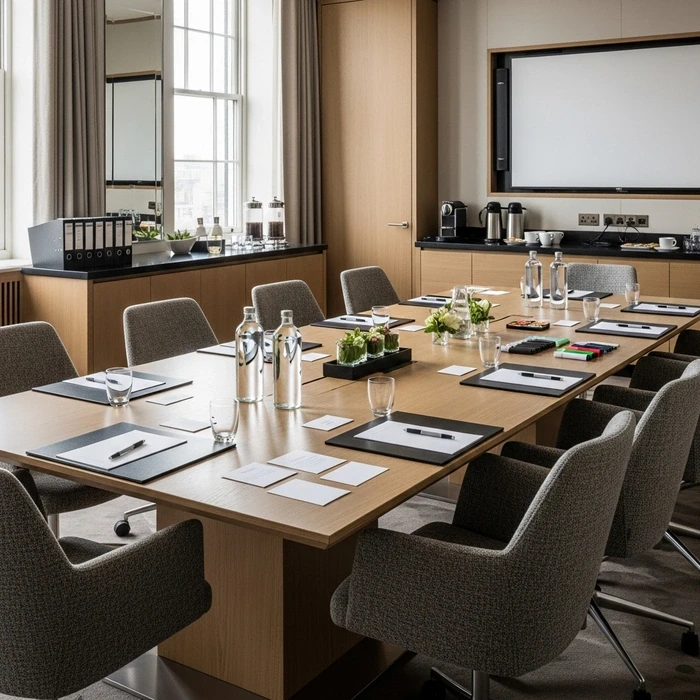
Day two of a three-day leadership program in Riyadh. Facilitator B walks in cold. She has no idea what Facilitator A covered yesterday. Participants notice immediately. They disengage. The program's credibility collapses before lunch.
This scenario repeats across the Middle East every quarter. Organizations invest heavily in multi-day corporate training but treat facilitator coordination as an afterthought. The result is redundant content, misaligned messaging, and confused participants who question the entire investment.
When you manage facilitators for multi-day training, the challenge is not talent. It is orchestration. Each facilitator brings expertise. But without a system that connects their sessions into a cohesive learning journey, individual brilliance becomes collective chaos.
This guide breaks down the operational framework used by corporate L&D teams running multi-day, multi-speaker training programs across the UAE, Saudi Arabia, and Qatar. Every section addresses a specific failure point and the exact system to prevent it.
Why multi-day training becomes chaotic
Most multi-day programs do not break down because of weak content. They break down because facilitators operate in silos. Without strong facilitator management, sessions overlap, important concepts fall through the cracks, and the participant experience becomes fragmented.
In regional corporate training, this issue is amplified by logistics. Trainers may be flying in from different cities, joining from different business units, or delivering under tight venue schedules. If no one owns the connections between sessions, chaos shows up quickly.
Common failure points in facilitator management
Here are the issues that most often undermine a program:
No clear owner for transitions between sessions
Duplicate examples, frameworks, or case studies
Inconsistent terminology across facilitators
Weak handoffs between trainers
No documented trainer coordination process
Last-minute changes to the facilitator schedule
Breakout leaders who were never properly briefed
No moderator to control timing and audience flow
In practice, this means participants hear the same point twice, miss a key topic entirely, or lose trust in the structure of the program.
Build a multi-facilitator training plan before content starts
The simplest way to manage facilitators for multi-day training is to stop treating each session as a standalone presentation.










Instead, build one integrated multi-facilitator training plan that covers people, content, timing, room flow, and contingency actions.
Start with a RACI for every session block
Use a RACI matrix to define who is responsible, accountable, consulted, and informed for each part of the program.
For example, your matrix should clarify:
Who opens each day
Who owns session transitions
Who handles Q&A moderation
Who manages breakout facilitation
Who escalates technical or participant issues
Who closes the day and summarizes takeaways
This is especially useful when several internal and external trainers are involved. It removes ambiguity and makes training delivery roles visible from the start.
Map content alignment across the full journey
A good agenda is not enough. You need content alignment across all facilitators.
Create a shared content map that shows:
Session objectives
Key models or terminology used
Knowledge assumed from previous sessions
Activities linked to specific learning outcomes
Where each facilitator picks up from the previous one
If one facilitator introduces a model on day one, the next facilitator should know exactly how to reference it on day two. That level of continuity is what participants remember.
For a broader planning framework, read plan multi-day corporate training programs.
Create a trainer briefing document that leaves no gaps
A weak briefing pack is one of the fastest ways to lose control. Every trainer should receive a complete trainer briefing document well before the event.
What your trainer briefing document should include
Your document should cover:
Event objectives and business context
Audience profile and seniority mix
Full facilitator run of show
Session start and end times
Break timings and venue access windows
Slide deadlines and file naming rules
AV setup and room configuration
Teaching notes for each session
Breakout instructions
Contact list and escalation path
Rules for Q&A, moderation, and participant issues
The goal is simple: no facilitator should arrive guessing.
Standardize assets across all trainers
Use standardized slide templates and shared formatting guidelines. A training program with five completely different presentation styles feels disconnected, even if the content is strong.
Standardization helps with:
Brand consistency
Faster speaker prep
Easier version control
Better visual flow for participants
More efficient quality assurance
It also reduces stress for the event team managing files onsite.
Use a facilitator run of show, not just an agenda
An agenda tells participants what happens. A facilitator run of show tells the delivery team exactly how it happens.
That difference matters.
What to include in the facilitator run of show
Your run of show should include:
Minute-by-minute timing
Speaker arrival times
Microphone and laptop assignments
Transition wording
Breakout reset windows
Poll launches or digital interaction cues
Moderator prompts
Buffer time for delays
Backup plans if a trainer is late
This document becomes the operational backbone of the training.
If your program includes virtual contributors or hybrid segments, our guide on hybrid event run of show is useful for adapting timing and speaker flow.
Make handoffs between trainers feel seamless
Participants should never feel the friction between facilitators. Smooth handoffs between trainers are one of the clearest signs of a well-run program.
Use a repeatable transition protocol
Every transition should follow a simple structure:
Outgoing facilitator summarizes the main takeaway
Moderator links that takeaway to the next topic
Incoming facilitator references the prior session in their opening
The next segment begins without confusion or dead time
This creates continuity and reinforces the idea that the whole program is designed as one journey.
Rehearse transitions, not just presentations
Most teams rehearse slides. Few rehearse transitions.
Before the event, run at least one full coordination session covering:
Session openings
Session closings
Cross-references between facilitators
Timing discipline
Q&A handling
Backup plans for late arrivals or technical issues
These rehearsals reveal overlap, gaps, and awkward transitions early, when they are still easy to fix.
Define training delivery roles clearly
A common source of confusion is overlapping responsibility. One person thinks they are leading. Another thinks they are moderating. A third assumes the venue team will handle participant movement.
Clear training delivery roles prevent that.
Key roles for multi-day corporate training
For smoother execution, assign the following:
Lead facilitator
Owns the learning arc, key messages, and overall tone.
Session facilitators
Deliver assigned modules and follow agreed teaching notes.
Moderator
Handles introductions, moderation, timing, and the question parking lot.
Breakout leads
Own breakout facilitation, instructions, room movement, and debrief capture.
Program coordinator
Manages trainer logistics, room resets, materials, and escalation.
Technical support lead
Handles AV checks, presentation loading, and live troubleshooting.
When these roles are explicit, speaker management for training becomes much easier.
Plan for venue and logistics realities in the Middle East
In the Gulf, training quality is often shaped by logistics as much as by content. Venue layout, travel timing, prayer breaks, catering flow, and meeting-room access all influence how well facilitators perform.
Choose a venue that supports facilitator movement
For multi-day training, the venue should offer:
Main training room plus breakout rooms
Reliable AV and on-call support
Private prep space for trainers
Easy registration and participant flow
Business-friendly catering windows
Flexible room reset options across multiple days
This is where Flaash adds value. For companies organizing corporate training in Dubai, Abu Dhabi, Riyadh, Jeddah, Doha, or Dammam, the right venue can reduce transition delays, improve facilitator readiness, and protect the participant experience.
Build logistics into the delivery plan
Do not treat logistics as separate from learning delivery. Include in your planning:
Facilitator travel and trainer availability
Time needed for morning setup
Prayer and meal break timing
Room changes between plenary and breakout sessions
Badge, material, and attendance tracking
Onsite contact points for urgent issues
A strong starting point is this multi-day training logistics checklist.
Improve engagement with better adult learning design
Facilitator management is not only about logistics. It is also about ensuring that the delivery model supports adult learning.
The research in Adult Learning Theory reinforces a practical truth: adults learn better when training is relevant, participatory, and immediately applicable.
Translate learning theory into facilitator instructions
Tell facilitators to plan for:
Real business examples
Peer discussion
Reflection moments
Applied exercises
Structured Q&A
Problem-solving in groups
This is where teaching notes become valuable. Instead of telling a trainer to “cover a topic,” specify how participants should engage with it.
Manage the question parking lot properly
In multi-day programs, discussions can easily derail timing. A question parking lot helps preserve flow without dismissing participant input.
Use it for:
Off-topic but valuable questions
Issues requiring follow-up from another speaker
Questions better addressed during panel discussion or recap
Topics that need a later module for proper context
This supports both participant management and timing control.
Prepare for last-minute trainer changes
Even the best facilitator schedule can change. Flights are delayed. Internal stakeholders get pulled into urgent meetings. Trainers get sick.
If your plan does not account for that, your training program is fragile.
Have a backup facilitator for critical sessions
For core modules, assign a backup facilitator who has access to:
Slide deck
Teaching notes
Audience brief
Session objectives
Key examples and case references
A backup is only useful if they are pre-briefed. Otherwise, you are simply replacing one risk with another.
Document the escalation path
Your written escalation path should state:
Who decides to activate the backup
Who updates the run of show
Who informs the moderator and venue team
Who communicates with participants if needed
This reduces delay and keeps the event team aligned under pressure.
Run daily quality assurance across the program
Multi-day training should never be managed as “set and forget.” You need active quality assurance every day.
Use a daily calibration meeting
At the end of each day, gather facilitators and coordinators for a 15- to 20-minute review.
Discuss:
What landed well with participants
Where timing slipped
Which questions kept recurring
Where confusion appeared
What content needs clarification tomorrow
Whether transitions need to be tightened
This daily adjustment cycle is one of the most effective ways to strengthen a live program while it is still in progress.
Score facilitators on the same criteria
Use a simple evaluation rubric covering:
Content clarity
Engagement quality
Alignment with session objectives
Timing discipline
Collaboration with other facilitators
Responsiveness to participant needs
This makes facilitator management more objective and helps identify where additional support is needed.
For agenda design that supports stronger delivery flow, see multi-day training agenda design.
Practical checklist to manage facilitators for multi-day training
If you want a simpler summary, here is the operational checklist:
Build a multi-facilitator training plan
Assign a RACI for all delivery responsibilities
Confirm trainer availability early
Create one complete trainer briefing document
Standardize slide templates and file rules
Write a detailed facilitator run of show
Rehearse transitions and handoffs
Define moderation and breakout roles
Align venue layout with learning format
Use a question parking lot
Prepare an escalation path
Pre-brief a backup facilitator
Run daily quality assurance reviews
Conclusion
To manage facilitators for multi-day training without chaos, you need more than good speakers. You need a system that connects people, content, timing, venue logistics, and contingency planning.
The companies that do this well are not just better organized. They get better training outcomes, stronger participant satisfaction, and better ROI from every day invested.
For corporate training programs across the UAE, Saudi Arabia, and Qatar, execution detail matters. And when venue coordination is part of the challenge, Flaash helps companies simplify the logistics side so training teams can focus on delivery, engagement, and results.
FAQ: manage facilitators for multi-day training
How do I manage facilitators for multi-day training across UAE, Saudi Arabia, and Qatar?
Appoint a single lead coordinator, provide a shared run-of-show and learning objectives, hold a pre-event kickoff and daily brief/debriefs, and centralize materials and communication so facilitators deliver a consistent multi-day experience across sites.
How many facilitators should I schedule for multi-day corporate training?
For interactive sessions, plan 1 facilitator per 12–20 participants; for lecture formats, fewer. Also include a lead facilitator, a co-facilitator or MC for transitions, and at least one local backup per location.
Which tools work best to coordinate facilitators for multi-day training in the Gulf?
Use a project board, a shared drive, real-time messaging, and a calendar with a versioned run-of-show. For hybrid delivery, add Zoom or Teams with co-hosts and an LMS for materials and feedback.
What local scheduling and cultural considerations should I include when managing facilitators for multi-day training?
Build schedules around prayer times, national holidays, and Ramadan where relevant, provide bilingual English-Arabic materials if needed, and plan setup and room flow to match local business expectations.
What venue and logistical features help facilitators deliver multi-day training smoothly?
Ensure reliable high-speed Wi‑Fi, breakout rooms, strong AV with on-site tech support, a quiet facilitator prep room, nearby accommodation, and catering that minimizes disruptions during long training days.
How do I handle facilitator cancellations or last-minute changes during a multi-day program?
Maintain a vetted local backup roster, cross-train facilitators on key modules, design modular lesson plans for easy handover, include replacement clauses in contracts, and keep agenda buffer time for reassignment.



Recent Posts


Load More Blogs