
-
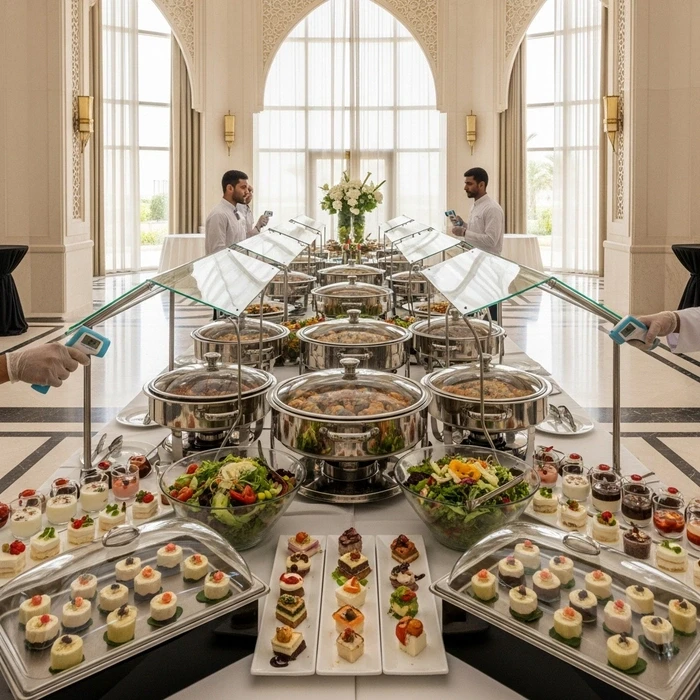
A single food safety violation at a corporate gala can trigger Dubai Municipality fines exceeding AED 100,000, collapse a vendor relationship overnight, and generate reputational damage no crisis communications team can contain. Yet most event managers across the UAE still treat catering compliance as an afterthought—a line item, not a strategic risk function.
This guide breaks down exactly what corporate event teams must enforce when sourcing catering for seminars, product launches, investor galas, and board-level functions across Dubai, Abu Dhabi, and the wider Gulf. Every protocol, every checkpoint, every legal threshold—mapped and actionable.
What Does UAE Federal Law Require for Event Catering Food Safety?
UAE federal and municipal regulations mandate that every caterer serving at a licensed corporate event holds valid food permits, employs staff with current food handling certification, and operates under a documented HACCP plan aligned with emirate-level enforcement standards.
Federal Food Safety Law No. 10 of 2015
The UAE's primary legislative framework is Federal Law No. 10 of 2015 concerning food safety. It governs every entity in the food supply chain—caterers included. The law mandates full traceability from ingredient sourcing to final plate service. Non-compliance penalties range from AED 10,000 to AED 5,000,000 and can include immediate facility closure.
The Ministry of Climate Change and Environment (MOCCAE) oversees federal enforcement. However, emirate-level authorities handle day-to-day inspections and licensing. In Dubai, that responsibility falls to the Dubai Municipality food safety department. In Abu Dhabi, ADAFSA governs. Different emirates, different inspection cadences, same zero-tolerance posture.
Emirate-Level Permits and Inspections
Every caterer operating at a corporate event must hold a valid trade license and food permits issued by the relevant emirate authority. For events hosted at hotels and resorts across the UAE, the venue's own food safety star rating often dictates whether an external caterer can even operate on-site. Some five-star properties—Jumeirah Al Naseem, The St. Regis Abu Dhabi—prohibit outside caterers entirely unless they hold matching certifications.
Dubai Municipality conducts both scheduled and surprise inspections. If your event caterer receives a critical violation—improper hot holding temperatures, evidence of cross-contamination—the event can be shut down mid-service. That risk sits with you, the event organizer, not just the caterer.
International Standards That Apply
Many Tier 1 caterers in the UAE voluntarily align with ISO 22000, the international food safety management standard. The Codex Alimentarius guidelines also serve as the baseline reference that UAE regulators draw from. When vetting caterers for high-profile corporate functions, asking for ISO 22000 certification is one of the strongest proxies for operational maturity.
How Should You Vet a Caterer's HACCP and Halal Compliance?
Require documented proof of a caterer's HACCP plan, current Halal certification from a UAE-accredited body, and evidence of recent supplier audits before signing any catering contract for a corporate function.
Evaluating the HACCP Plan
HACCP catering UAE compliance is non-negotiable. A legitimate HACCP plan identifies critical control points across receiving, storage, cooking, holding, and serving. Ask the caterer to walk you through their documented plan. If they cannot produce it within 24 hours of your request, disqualify them.
Key questions to ask during vetting:
Where are your critical control points documented and who audits them?
How do you manage cold chain breaks during transport to off-site venues?
What is your corrective action procedure when a temperature excursion is logged?
Halal Certification and Supply Chain Integrity
Halal catering compliance in the UAE requires certification from bodies accredited by ESMA (Emirates Authority for Standardization and Metrology). A certificate alone is insufficient. You must verify that the entire supply chain—meat processors, dairy suppliers, ingredient distributors—maintains Halal integrity end to end. This means reviewing supplier audits of sub-contractors, not just the caterer's own kitchen.
For multinational corporate events, this matters beyond cultural respect. Serving non-Halal food at a UAE corporate function represents a legal and reputational risk that most global event teams underestimate significantly.
Flaash Expert Insight: When sourcing caterers for large-scale seminars in Dubai, request the caterer's most recent Dubai Municipality inspection report alongside their HACCP documentation. A clean inspection record from the last 90 days is more revealing than any capabilities presentation.
Food Handling Certification for On-Site Staff
Every individual handling food at your event must hold a valid food handling certification. In Dubai, this means completing the Dubai Municipality-approved food handler training program. Verify certifications for every staff member assigned to your event—not just the head chef. Request a roster with certification expiry dates 72 hours before the function.
What Are the Critical Temperature Controls for Corporate Event Catering?
Food served at corporate events must maintain hot holding above 63 degrees Celsius and cold holding below 5 degrees Celsius, with documented temperature logs recorded at minimum every 30 minutes throughout service.
Hot Holding and Cold Chain Standards
Temperature control catering is where the majority of food safety failures occur at corporate events. The UAE adopts Codex-aligned temperature thresholds that are strictly enforced:
Hot holding: all cooked food must remain above 63 degrees Celsius. Chafing dishes and heat lamps are standard, but they frequently fail to maintain compliant temperatures—particularly during outdoor receptions in cooled tent setups.
Cold chain: perishable items must stay below 5 degrees Celsius from preparation through transport to final service. Any documented break in the cold chain requires the item to be discarded. Re-chilling is not an acceptable corrective action.
Transport and Staging Risks
The UAE's ambient temperatures—regularly exceeding 45 degrees Celsius from May through September—create unique hazards during food transport. Catering vehicles must be actively refrigerated, not passively insulated. Staging areas at major venues like DWTC, Madinat Jumeirah, or ADNEC in Abu Dhabi need dedicated holding zones with verified and logged temperature control.
Ask your caterer directly: what is your maximum transport time from kitchen to venue? If the answer exceeds 90 minutes without active refrigeration, escalate the issue immediately.
Buffet Service Protocols
Corporate buffets at product launches and galas require buffet guards (sneeze guards) on all open food stations. Serving utensils must be replaced or sanitized every 30 minutes during continuous service. Food items displayed for more than two hours at non-compliant temperatures must be removed and discarded. No exceptions, no judgment calls by junior staff.
Flaash Expert Insight: For corporate events at conference venues across Abu Dhabi, confirm that your caterer maintains a written protocol for temperature logging during outdoor receptions. Ambient heat in the Capital can push buffet items past safe thresholds within 20 minutes of plating.
How Do You Handle Allergen Labelling and Special Diets at Corporate Events?
Every dish served at a corporate event must display clear allergen labels identifying the 14 major allergens, and the catering team must operate a documented protocol for managing special diet requests and medical escalation procedures.
UAE Allergen Labelling Requirements
Allergen labelling UAE requirements mandate disclosure of all major allergens including gluten, tree nuts, peanuts, dairy, shellfish, soy, and eggs. This applies to both pre-packaged and freshly prepared food served at events. Labeling standards must be visible at the point of service—printed tent cards at each station, not buried in a back-of-house folder.
For seminars and conferences across the UAE, where attendee counts can reach several hundred, allergen management becomes a serious logistics challenge. Pre-event registration should capture dietary requirements no fewer than 72 hours before the function date.
Managing Special Diets at Scale
Special diets—vegan, gluten-free, low-sodium, Jain, kosher—are standard expectations at multinational corporate events in the Gulf. Your caterer must demonstrate a separate preparation workflow for each dietary category. This means dedicated prep surfaces, distinct serving utensils, and staff trained specifically in cross-contamination prevention protocols.
Medical Escalation Protocols
What happens if an attendee has an allergic reaction mid-event? Your catering contract must include a medical escalation clause specifying:
Location of on-site first aid equipment and epinephrine auto-injectors
Contact details and drive time for the nearest hospital
Identification of catering staff trained in anaphylaxis first response
Do not assume the venue handles this by default. Confirm every detail in writing before the event date.
What Should Your On-Site Catering Hygiene Checklist Cover?
A comprehensive catering hygiene checklist for corporate events must address staff PPE compliance, sanitization station placement, waste disposal frequency, temperature logging, and real-time corrective action authority granted to the event manager.
All catering staff must wear appropriate PPE—gloves, hairnets, and aprons at minimum. Sanitization stations should be positioned at every food preparation and service point. Before your first guest arrives, conduct a thorough back-of-house walkthrough and verify that refrigeration units operate at or below 5 degrees Celsius, dry storage is elevated off the floor, cleaning chemicals are stored separately from food, and waste bins are lined, covered, and scheduled for removal at defined intervals. Document all findings with timestamped photographs.
The event manager must hold contractual authority to halt catering service if a critical violation is observed. This authority needs to be written explicitly into the catering agreement.
How Do You Build a Catering Risk Assessment for Corporate Events?
A catering risk assessment maps every hazard from supplier sourcing through final service, assigning controls, responsible owners, and escalation paths within a documented risk register reviewed before every event.
A catering risk assessment begins with a formal risk register. List every identifiable hazard: supplier failure, cold chain break, allergen mislabelling, power outage affecting refrigeration, key staff illness on event day. For each hazard, assign a likelihood score, an impact score, a specific control measure, and a named responsible owner.
Supplier audits function as your most critical upstream control. Your caterer should demonstrate full traceability for every ingredient—from farm or manufacturer to the finished plate. For high-profile board meetings and investor functions, request the caterer's supplier audit log covering the preceding six months.
Your incident response plan should address suspected foodborne illness, allergen exposure, and regulatory inspection during the event. Designate a single liaison from your team, and ensure all permits, temperature logs, and HACCP documentation are accessible within five minutes.
Flaash Expert Insight: For Dubai-based conferences and seminars, build a dedicated pre-event food safety briefing into your run-of-show. A focused 15-minute alignment session between your event team, the caterer's head chef, and the venue's facilities manager eliminates roughly 80 percent of day-of operational surprises.
Compliance Is the Competitive Advantage Most Event Teams Overlook
The margin between a flawless corporate event and a reputational crisis often sits in how rigorously you enforce event catering food safety UAE protocols. In a region where regulatory standards are tightening year over year and corporate stakeholder expectations have never been higher, food safety is not a back-of-house task—it is a boardroom-level decision. Treat your next catering brief like a procurement audit. Demand the documentation. Verify it on-site. And retain the authority to act the moment standards slip.










How Do You Handle Allergen Labelling and Special Diets at Corporate Events?
Every dish served at a corporate event must display clear allergen labels identifying the 14 major allergens, and the catering team must operate a documented protocol for managing special diet requests and medical escalation procedures.
UAE Allergen Labelling Requirements
Allergen labelling UAE requirements mandate disclosure of all major allergens including gluten, tree nuts, peanuts, dairy, shellfish, soy, and eggs. This applies to both pre-packaged and freshly prepared food served at events. Labeling standards must be visible at the point of service—printed tent cards at each station, not buried in a back-of-house folder.
For seminars and conferences across the UAE, where attendee counts can reach several hundred, allergen management becomes a serious logistics challenge. Pre-event registration should capture dietary requirements no fewer than 72 hours before the function date.
Managing Special Diets at Scale
Special diets—vegan, gluten-free, low-sodium, Jain, kosher—are standard expectations at multinational corporate events in the Gulf. Your caterer must demonstrate a separate preparation workflow for each dietary category. This means dedicated prep surfaces, distinct serving utensils, and staff trained specifically in cross-contamination prevention protocols.
Medical Escalation Protocols
What happens if an attendee has an allergic reaction mid-event? Your catering contract must include a medical escalation clause specifying:
Location of on-site first aid equipment and epinephrine auto-injectors
Contact details and drive time for the nearest hospital
Identification of catering staff trained in anaphylaxis first response
Do not assume the venue handles this by default. Confirm every detail in writing before the event date.
What Should Your On-Site Catering Hygiene Checklist Cover?
A comprehensive catering hygiene checklist for corporate events must address staff PPE compliance, sanitization station placement, waste disposal frequency, temperature logging, and real-time corrective action authority granted to the event manager.
All catering staff must wear appropriate PPE—gloves, hairnets, and aprons at minimum. Sanitization stations should be positioned at every food preparation and service point. Before your first guest arrives, conduct a thorough back-of-house walkthrough and verify that refrigeration units operate at or below 5 degrees Celsius, dry storage is elevated off the floor, cleaning chemicals are stored separately from food, and waste bins are lined, covered, and scheduled for removal at defined intervals. Document all findings with timestamped photographs.
The event manager must hold contractual authority to halt catering service if a critical violation is observed. This authority needs to be written explicitly into the catering agreement.
How Do You Build a Catering Risk Assessment for Corporate Events?
A catering risk assessment maps every hazard from supplier sourcing through final service, assigning controls, responsible owners, and escalation paths within a documented risk register reviewed before every event.
A catering risk assessment begins with a formal risk register. List every identifiable hazard: supplier failure, cold chain break, allergen mislabelling, power outage affecting refrigeration, key staff illness on event day. For each hazard, assign a likelihood score, an impact score, a specific control measure, and a named responsible owner.
Supplier audits function as your most critical upstream control. Your caterer should demonstrate full traceability for every ingredient—from farm or manufacturer to the finished plate. For high-profile board meetings and investor functions, request the caterer's supplier audit log covering the preceding six months.
Your incident response plan should address suspected foodborne illness, allergen exposure, and regulatory inspection during the event. Designate a single liaison from your team, and ensure all permits, temperature logs, and HACCP documentation are accessible within five minutes.
Flaash Expert Insight: For Dubai-based conferences and seminars, build a dedicated pre-event food safety briefing into your run-of-show. A focused 15-minute alignment session between your event team, the caterer's head chef, and the venue's facilities manager eliminates roughly 80 percent of day-of operational surprises.
Compliance Is the Competitive Advantage Most Event Teams Overlook
The margin between a flawless corporate event and a reputational crisis often sits in how rigorously you enforce event catering food safety UAE protocols. In a region where regulatory standards are tightening year over year and corporate stakeholder expectations have never been higher, food safety is not a back-of-house task—it is a boardroom-level decision. Treat your next catering brief like a procurement audit. Demand the documentation. Verify it on-site. And retain the authority to act the moment standards slip.
FAQ: event catering food safety UAE
What are the food safety regulations for event catering in the UAE?
The UAE enforces strict food safety regulations governed by authorities such as Dubai Municipality and Abu Dhabi's ADAFSA. Corporate event caterers must comply with HACCP standards, maintain valid trade licenses, and follow hygiene protocols covering food handling, storage temperatures, and transportation to ensure guest safety.
Do corporate event caterers in the UAE need a food safety license?
Yes, all corporate event caterers in the UAE must hold a valid food safety license issued by the local municipality. This includes obtaining a food handler permit, passing regular health inspections, and ensuring all staff complete approved food safety training courses before serving at any corporate function.
How can you ensure food safety at a corporate event in the UAE?
Choose a caterer that holds HACCP certification and a valid municipal food safety license. Verify that they use temperature-controlled transport, conduct allergen labeling, and follow proper hygiene protocols. Platforms like Flaash can help you source vetted venues and catering partners that meet UAE compliance standards.
What is HACCP and why does it matter for UAE event catering?
HACCP stands for Hazard Analysis and Critical Control Points, a systematic food safety management framework. In the UAE, corporate event caterers are expected to implement HACCP plans to identify potential hazards, monitor critical processes, and prevent contamination throughout preparation, transport, and service at the venue.
What temperature requirements apply to catered food at UAE corporate events?
Hot catered food must be maintained at or above 63 degrees Celsius, while cold items should be kept at or below 5 degrees Celsius. UAE food safety authorities require caterers to use calibrated thermometers and chafing equipment to monitor temperatures consistently throughout the duration of any corporate event.
Who is responsible if food safety issues occur at a corporate event in the UAE?
The licensed catering company bears primary legal responsibility for food safety incidents at corporate events in the UAE. However, event organizers share a duty of care by selecting compliant vendors, verifying certifications in advance, and ensuring the chosen venue provides adequate kitchen facilities and proper food storage conditions.



Recent Posts



Load More Blogs