
-
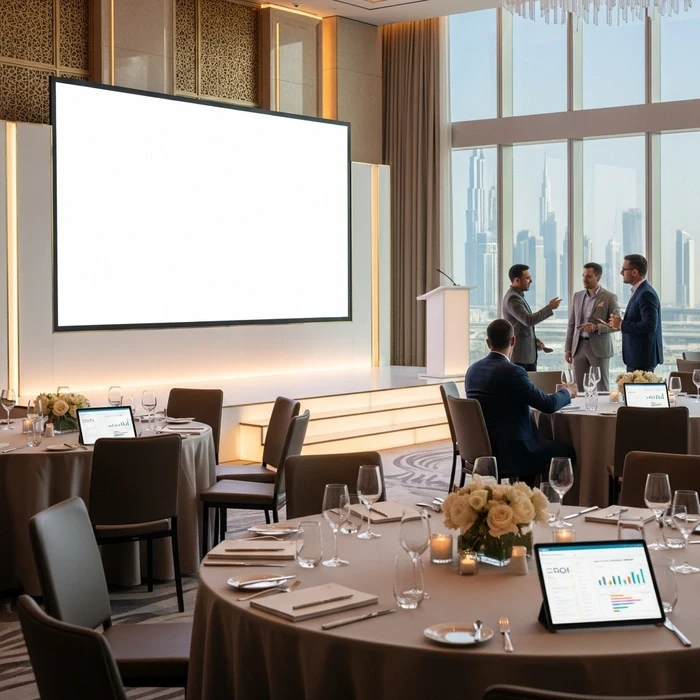
Most sales leaders in the GCC know their events work. Fewer can prove it with numbers that hold up in a budget review. That gap matters. In the UAE, Saudi Arabia, and Qatar, in-person sales events still play a major role in enterprise growth, but they are also expensive, resource-heavy, and often measured inconsistently.
This is why defining realistic sales event ROI benchmarks GCC teams can use is so important. Whether you run field marketing events, executive roundtables, roadshows, customer events, partner events, or hosted meetings, you need benchmarks that reflect how sales actually happen in the region. GCC markets often involve longer procurement cycles, multilingual stakeholders, layered decision-making, and regional account coverage across multiple cities and countries.
This article outlines practical benchmark ranges, not fake precision. It explains what to measure by funnel stage, how to think about B2B event pipeline benchmarks in account-based programs, and how better operations can improve measurement quality. For a broader planning view, see corporate event ROI benchmarks GCC.
Why sales event ROI benchmarks in the GCC need a regional lens
Many global benchmark reports are useful as directional references, but GCC sales motions are not identical to North America or Europe. In this region, enterprise deals often involve more in-person trust building, broader relationship mapping, and slower approvals in sectors such as public sector, energy, infrastructure, healthcare, and financial services.
That affects how you should interpret event performance.
A sales event in Dubai aimed at private-sector technology buyers may show pipeline movement within one quarter. A similar event in Riyadh targeting government-linked stakeholders may influence a deal that closes nine to eighteen months later. A customer event in Doha may engage a smaller audience, but with higher account concentration and stronger expansion potential.
So the goal is not to find one universal number. It is to set event ROI KPIs for sales that reflect your motion, segment, and market.
What good sales event ROI looks like
As a broad reference, a strong GCC sales event often delivers a 3:1 to 7:1 ROI on fully loaded cost over an appropriate attribution window. For highly targeted hosted meetings or executive roundtables, that can go higher. For broad roadshows, it may be lower but still worthwhile if pipeline quality is strong.
The biggest mistake is measuring too early or too narrowly.
Influence vs sourced pipeline
A core benchmarking principle is separating influence vs sourced pipeline.
Event sourced revenue benchmarks refer to opportunities created directly from event engagement.
Event influenced pipeline benchmark refers to opportunities already in motion that advanced faster, expanded in value, or progressed because of the event.
In GCC B2B sales, many events influence more pipeline than they source. That is especially true for executive roundtables, customer events, and partner events, where the real value often comes from opportunity acceleration, stronger stakeholder alignment, and improved win conditions.
A reasonable rule of thumb for many enterprise programs is:
25% to 40% sourced impact
60% to 75% influenced impact
This mix varies by event type, but it reflects the reality that in-person events are often mid-funnel and late-funnel growth levers, not just lead generation channels.









Benchmarking by event type
Different sales event formats should not be judged against the same target.
Executive roundtables
Executive roundtables usually have smaller audiences but stronger commercial intent.
Typical performance ranges:
ROI: 5:1 to 8:1
Contact-to-meeting: 45% to 60%
Opportunity creation from qualified attendees: 20% to 35%
Above-baseline win rate uplift on event-touched deals: 15% to 25%
These events work best when the attendee list is tightly curated, sales follow-up is pre-assigned, and the venue supports high-quality discussion.
Roadshows
Roadshows trade intimacy for scale and regional reach.
Typical performance ranges:
ROI: 3:1 to 5:1
Contact-to-meeting: 15% to 25%
Qualified lead to opportunity: 15% to 25%
Account coverage impact: often stronger than direct close-rate impact in the short term
Roadshows are especially relevant in the GCC because regional sales coverage often spans multiple cities such as Dubai, Abu Dhabi, Riyadh, Jeddah, Doha, and Dammam. Their value often lies in widening target-account access and generating multiple local touchpoints.
Customer and partner events
These events are often undervalued because teams focus only on new logo pipeline.
Typical performance ranges:
ROI: 4:1 to 7:1
Expansion opportunity influence: high
Multi-thread stakeholder engagement: strong
Deal acceleration on active accounts: meaningful
For account growth, they often outperform broad prospecting events because trust is already established.
Hosted meetings
Hosted meetings can produce some of the strongest ROI when aligned with a major industry event or targeted travel calendar.
Typical performance ranges:
ROI: 6:1 to 10:1
Meeting set rate: 50%+ for well-targeted invite lists
Opportunity conversion: 25% to 40%
Because the format is so targeted, success depends heavily on account selection, pre-booked agendas, and disciplined follow-up.
Funnel-stage benchmarks for sales events
A useful benchmarking model breaks event performance into stages. This is where B2B event pipeline benchmarks become more actionable.
Top of funnel: attendance quality and meeting creation
At the top of funnel, raw registration volume matters less than the commercial quality of attendees.
Key benchmarks:
Show rate from confirmed registration: 60% to 80%, depending on format
Target account attendance rate: 15% to 25% of invited Tier 1 accounts
Contact-to-meeting conversion: 15% to 55%, depending on format
Post-event meeting requests within 14 days: 8% to 12% of total attendees
A broad event can have excellent attendance and still weak sales value if the audience does not match your ICP or target account list.
Mid funnel: lead qualification and sales acceptance
This is where teams often lose momentum.
Useful benchmarks:
Event lead conversion rate benchmark from attendee to MQL: 20% to 40%
MQL SQL benchmark events range: 25% to 40%
Sales acceptance within SLA: 70%+
Qualified lead to opportunity: 20% to 35%
These numbers depend on lead scoring, clear qualification criteria, and whether the event was built for broad awareness or commercial progression.
In the GCC, qualification can take longer because buying groups are more layered. One attendee may not be the budget owner. Another may be the internal champion. This is why B2B sales teams should avoid over-penalizing event programs that create strong buying-group access even if immediate SQL numbers are moderate.
Bottom funnel: pipeline conversion and revenue impact
At the bottom of funnel, the strongest event programs typically show benefits in conversion efficiency rather than just volume.
Benchmarks to watch:
Win rate uplift on event-touched opportunities: 15% to 25%
Reduction in sales cycle length: 10% to 20%
Increase in deal velocity for event-engaged accounts: measurable within one or two stages
Expansion in average deal size for customer and partner motions: often positive where multiple stakeholders attend
This is where event sourced revenue benchmarks and influenced pipeline should be reviewed together. If an event generates few net-new opportunities but materially improves progression of high-value existing deals, it may still be one of the strongest revenue drivers in the portfolio.
ABM event metrics for GCC sales teams
For account-based programs, the unit of success is not the lead. It is the account.
That changes the benchmark model.
Account coverage benchmark
A useful account engagement benchmark is the percentage of target accounts reached meaningfully by the event.
Typical ranges:
Tier 1 account attendance: 15% to 25%
Tier 2 account attendance: 20% to 35%
Accounts with at least one measurable post-event action: 60%+ of attending target accounts
This matters in the GCC because buying committees are often broad and relationship-driven. A single attendee rarely represents the full buying center.
Multi-threading and touchpoints
Strong ABM event metrics include:
Average contacts engaged per attending account: 2.3 to 3.1
Number of meaningful touchpoints per opportunity where events contribute: 2 to 4
Stage progression within 45 days for engaged accounts: 25% to 40%
If your event only engages one contact per account, the commercial impact may be limited. If it adds senior, technical, and procurement stakeholders into the same account narrative, ROI improves even if the lead count stays low.
Intent signals and attribution
Events create rich intent signals when tracked properly:
1:1 meeting requests
session attendance
booth or demo engagement
repeat attendance
executive participation
content follow-up requests
These signals should feed CRM campaign attribution and account scoring. Without that structure, your event data becomes anecdotal.
To build a stronger measurement framework, align event reporting with an event attribution model UAE and centralize visibility in an event ROI dashboard UAE.
GCC market factors that change your benchmarks
Regional context matters.
UAE
The UAE is generally the most mature events market in the GCC. Buyers are used to polished experiences, organized registration flows, and commercial follow-up. Attribution practices also tend to be more developed.
This means benchmark consistency is often stronger, especially in Dubai and Abu Dhabi.
Saudi Arabia
Saudi Arabia offers significant growth potential but often requires longer planning and attribution windows. In some sectors, procurement and approval layers can be substantially slower than in the UAE.
That means:
shorter-term ROI can appear weaker than long-term ROI
pipeline contribution should be reviewed over 9 to 18 months in some sectors
account-level progression may be a better leading indicator than immediate opportunity creation
Qatar
Qatar is a smaller but often highly concentrated market. Well-targeted events can reach a meaningful share of the addressable audience quickly. Deal sizes may justify higher per-event costs, even if lead volume is relatively modest.
Multilingual audiences and regional sales coverage
Another GCC-specific factor is language. Sales events often include Arabic and English speakers, and in some cases additional language needs. This affects:
content comprehension
participation quality
meeting set rate
follow-up relevance
Multilingual event operations can improve both attendee experience and measurement quality. If the audience is more engaged, your contact-to-meeting and progression benchmarks become more reliable.
Cost efficiency benchmarks
A practical cost per lead benchmark GCC should be fully loaded, not based only on media or venue costs.
Indicative ranges:
Executive roundtables: AED 1,800 to AED 3,500 per qualified lead
Roadshows: AED 900 to AED 2,000 per qualified lead
Hosted meetings: AED 600 to AED 1,200 per qualified lead
The key phrase is qualified lead. If teams count every attendee, benchmarks become meaningless.
Also monitor:
cost per meeting set
cost per opportunity created
cost per influenced opportunity
event-related CAC where attribution maturity allows it
A lower cost per lead is not automatically better if deal quality is poor. In enterprise sales, the better benchmark is often cost per qualified opportunity or cost per dollar of pipeline influenced.
Why follow-up SLA is one of the most important KPIs
Few variables affect event ROI more directly than follow-up SLA.
A practical benchmark:
first sales follow-up within 24 to 48 hours
SDR or AE ownership assigned before the event
CRM tasks triggered immediately after attendance confirmation or check-in
Teams that delay outreach by a week often see significant drops in meeting set rate, SQL conversion, and downstream opportunity creation.
This is especially important in the GCC, where senior buyer calendars can be crowded and momentum after in-person engagement fades quickly if not captured.
How venue selection and event operations affect ROI measurement
Good measurement starts long before the post-event report. It starts with the event setup itself.
Venue quality influences:
check-in accuracy
session tracking
meeting logistics
networking flow
data capture reliability
A venue that supports structured registration, reliable connectivity, clear room flow, and controlled stakeholder interactions generates better event data. Better data means better attribution.
This is often overlooked. Companies may focus on reducing venue cost while unintentionally weakening the ability to measure engagement and prove ROI later. Better venue sourcing and smoother operations can therefore improve not just attendee experience, but the quality of KPI tracking itself.
That is one reason many regional teams benefit from a more structured venue-finding and event planning process, especially when running executive events, roadshows, or multi-city programs across the GCC. It supports more consistent execution and more defensible benchmark reporting. For teams comparing formats, it is also worth reviewing hybrid event ROI and hybrid event KPIs.
Conclusion
Strong sales event ROI benchmarks GCC teams can trust are not about one perfect number. They are about using realistic ranges, separating sourced from influenced impact, measuring by funnel stage, and benchmarking at the account level when running ABM motions.
In the UAE, Saudi Arabia, Qatar, and the wider GCC, event success depends on more than attendance. It depends on account quality, stakeholder depth, follow-up SLA, attribution discipline, and operational execution. Teams that measure those elements well can defend budgets more confidently and improve event performance over time.
The most effective approach is simple: set practical targets, review them by market and event format, and build measurement into the event design from the start.
FAQ: sales event ROI benchmarks GCC
What are typical sales event ROI benchmarks in the GCC?
A common benchmark is 3:1 to 5:1, meaning three to five dollars returned for every dollar spent. High-value sectors and well-targeted B2B events in cities like Dubai, Abu Dhabi, or Riyadh can exceed 5:1, while broader awareness events may fall below 3:1.
How do you calculate sales event ROI for GCC events?
Use this formula: (Revenue directly attributable to the event − Total event cost) ÷ Total event cost. Define an attribution window, include both sourced and influenced revenue, and count all costs such as venue, travel, marketing, staffing, and follow-up. CRM tracking helps connect deals to the event.
Which KPIs best measure sales event performance in the GCC?
The most useful KPIs include qualified leads generated, lead-to-opportunity conversion rate, pipeline influenced, cost per acquisition, revenue per attendee, post-event meeting bookings, and attendee engagement score. Combining short-term and medium-term KPIs gives a clearer view of performance.
What is the typical cost per lead (CPL) at GCC sales events?
A typical range is about $150 to $400 per lead, depending on industry and event format. CPL is often higher in enterprise tech, luxury, and finance, and lower in broader high-volume event formats. The more important measure is cost per qualified lead or cost per opportunity.
How do GCC sales event ROI benchmarks compare to global averages?
GCC benchmarks can match or exceed global averages because deal sizes are often larger and in-person trust-building is highly valuable. Many strong GCC events land in the 4:1 to 6:1 range, although performance still depends on targeting quality, follow-up, and event format.
What practical steps can improve sales event ROI in the UAE and Saudi Arabia?
Improve ROI by targeting high-value accounts, warming up attendees before the event, prioritizing onsite qualification, and following up within 24 to 48 hours. Localizing the experience for UAE and Saudi audiences and tracking results in CRM also helps improve future performance.



Recent Posts



Load More Blogs