
-
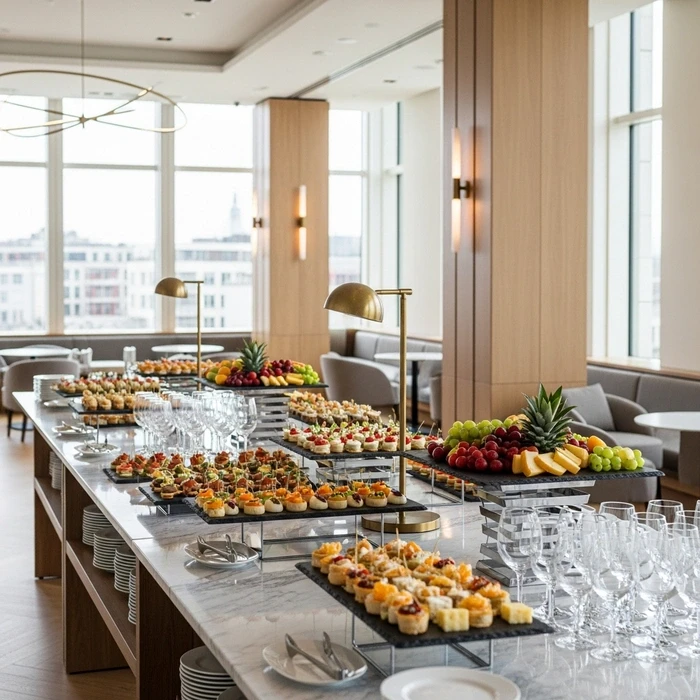
A single catering failure at a high-profile corporate event costs more than budget. It costs credibility. Across the GCC, event managers consistently rank catering coordination as their highest-risk operational variable. Yet most teams still evaluate vendors using generic spreadsheets with no weighted scoring and no structured verification process.
This corporate event catering checklist was built from hundreds of events managed across Dubai, Riyadh, and Doha. It gives you a repeatable framework to evaluate, compare, and contract catering vendors with precision — before a single plate hits the table.
What Should a Corporate Event Catering Checklist Actually Cover?
A complete checklist must cover three layers: menu design and dietary compliance, front-of-house service delivery standards, and back-of-house logistics including power, water, equipment, and permits. Evaluating food quality alone leaves the majority of your operational risk completely unaddressed.
Most corporate planners start with the menu. That is the wrong starting point. The menu is the output. The inputs are corporate catering requirements spanning compliance, logistics, and service delivery.
Your checklist must include:
Scope of work documentation — a written brief covering event format, guest profile, dietary mandates, and service style.
Permit requirements — municipality approvals, venue-specific catering licenses, and alcohol service permits where applicable. This is critical in UAE free zones versus mainland jurisdictions.
Insurance certificates — public liability coverage with minimum thresholds appropriate for your event scale and venue category.
In Saudi Arabia, catering permits now require digital registration through the Balady platform. In Qatar, events at hotels like The Ritz-Carlton Doha or Mondrian Doha require vendors to present municipality health cards for every staff member on-site. These details derail timelines when discovered late.
Structure your caterer comparison checklist around three scoring pillars:
Food — menu fit, dietary range, tasting notes, holding temperatures, allergen protocols.
Service — service timeline, staff-to-guest ratios, staff uniforms, guest interaction standards.
Logistics — setup plan, equipment list, power and water needs, waste management, breakdown schedule.
Each pillar should carry a weighted score. Food matters. But a flawless menu with a chaotic service team still fails.
How Do You Define the Scope of Work Before Contacting Caterers?
Define your scope of work by documenting event format, audience demographics, dietary complexity, service model (plated, buffet, or hybrid), and a minute-by-minute service timeline. This document becomes the single source of truth for every vendor conversation.
Corporate events in the Middle East serve uniquely diverse audiences. A product launch at DIFC Innovation Hub may host guests from fifteen or more nationalities. A board meeting in Riyadh's King Abdullah Financial District may require strict halal certification with specific slaughter standards.
Map your audience before writing a single menu line:
Halal compliance level — standard halal, or specific certification bodies required by attendees?
Vegetarian and vegan representation — in mixed international groups, plan for 20-30% plant-based dietary preferences at minimum.
Allergen management — document the top 14 allergens. Ensure your vendor follows cross-contact prevention protocols rigorously.
Cultural alcohol considerations — in Saudi Arabia, alcohol is prohibited. In the UAE, it requires a license. Understand standard serving definitions when managing beverage packages at licensed venues.
Your service timeline determines staffing, equipment, and kitchen load. A seated plated dinner for an awards gala requires a fundamentally different operation than a networking reception with live cooking stations. Document arrival beverage windows, transition timing between courses, speech breaks that pause service, and dessert and coffee alignment with the program close. Share this timeline during the RFP stage — not after contracting.
Flaash Expert Insight: For corporate galas and awards dinners in Dubai, source venues with integrated catering partnerships first. Browse awards dinner and networking venues in the UAE to shortlist spaces where kitchen infrastructure already supports high-volume plated service.
What Catering Evaluation Criteria Separate Top-Tier Vendors?
Top-tier vendors distinguish themselves through structured tasting protocols, verifiable references from similar-scale corporate events, current insurance and permits, and transparent pricing with clearly defined change control terms. Price alone is never a reliable differentiator.
Menu fit is not about how many dishes a caterer can list. It is about alignment between the caterer's strengths and your event's requirements. Request a custom menu proposal — not a generic brochure. Evaluate whether the proposal reflects your audience profile and dietary brief, whether seasonal and locally sourced ingredients are prioritized, and whether the menu is designed for the specific service format. Then schedule a tasting. Tasting notes should be recorded formally. Score each dish on presentation, temperature accuracy, portion sizing, and flavor balance. Bring a second evaluator. Subjective preferences alone should never drive a procurement decision.
Your catering evaluation criteria must include hard verification steps:
References — request three from corporate events of similar scale within the last twelve months. Call them. Ask about punctuality, crisis response, and final invoice accuracy.
Insurance certificates — verify public liability minimums. In the UAE, AED 5 million coverage is standard for large-scale corporate events.
Permit requirements — confirm municipality health permits, food handler cards, and transport vehicle certifications. In Dubai, the Food Safety Department under Dubai Municipality conducts unannounced inspections.
A vendor who hesitates to provide documentation is a vendor you eliminate from your shortlist.
How Should You Structure a Catering Site Visit Checklist?
A structured catering site visit checklist evaluates kitchen access, staging zones, cold and hot holding capacity, power and water supply adequacy, loading dock logistics, and service route mapping from kitchen to guest area. Never contract a caterer without completing this assessment at the actual venue.
If your event is at a venue without an in-house kitchen — common at exhibition halls like Abu Dhabi National Exhibition Centre or Riyadh Front — the caterer must bring mobile kitchen infrastructure. During the site visit, assess kitchen proximity to the service area, holding temperatures and equipment capacity, staging area footprint for plating and quality control, and waste disposal access that does not cross guest-facing areas.
Power and water needs are the most commonly underestimated variables in outdoor or semi-outdoor corporate events. Document available electrical capacity versus the caterer's equipment list requirements, water pressure and access points, generator backup availability — essential for outdoor setups at venues like Bab Al Shams in Dubai or desert-format events in AlUla, Saudi Arabia — and fire suppression placement near cooking stations.
Flaash Expert Insight: When sourcing venues for seminars and conferences that require complex catering setups, verify kitchen infrastructure before signing. Explore seminar and conference venues across the UAE to find spaces with pre-vetted catering capabilities and proven logistics.










What Does a Reliable Caterer Scorecard Look Like?
A reliable caterer scorecard assigns weighted scores across five categories — menu quality, service capability, logistical readiness, compliance documentation, and pricing transparency — enabling objective side-by-side vendor comparison.
Build your caterer scorecard with these five categories and suggested weights:
Category | Weight | What You Score |
|---|---|---|
Menu Quality | 25% | Tasting results, dietary range, presentation |
Service Capability | 25% | Staff ratios, staff uniforms, timeline adherence |
Logistical Readiness | 20% | Equipment, power plan, setup plan, breakdown |
Compliance | 15% | Permits, insurance, health certifications |
Pricing Transparency | 15% | Line-item detail, change control terms |
Score each category from one to five. Multiply by weight. The vendor with the highest composite score advances. This transforms your catering selection criteria from gut feeling into a defensible procurement process and establishes clear catering service levels that vendors must meet or exceed.
Red flags that disqualify immediately: no valid public liability insurance, refusal to provide references, inability to present a written setup plan, no documented allergen management process, or vague change control terms.
How Do You Build a Contingency Plan Into Every Catering Contract?
Every catering contract must include a written contingency plan covering last-minute guest count changes, menu substitutions, equipment failure protocols, and staffing backup commitments with pre-agreed cost implications.
Change control defines how modifications are handled after contract signing. Guest count adjustment windows — most caterers require final numbers 72 hours before the event. Define the percentage buffer, typically 5-10% overage. Menu substitutions — if a key ingredient becomes unavailable, what is the approval workflow? Additional service requests — extra stations, extended hours, or added courses must have pre-agreed per-unit pricing.
Your contingency plan must also address staffing gaps with backup staff on standby within a defined radius, equipment failure with written replacement timelines for critical items like ovens and chillers, and delivery failure with an alternate supply chain for perishables.
Flaash Expert Insight: For multi-day corporate events in Dubai, shortlist caterers who have operated at your chosen venue before. Search Dubai seminar and conference venues to find spaces with established vendor relationships that reduce last-mile risk.
What KPIs Should You Track After the Event?
Track five post-event KPIs: service timeline adherence, food quality consistency, guest satisfaction scores, waste percentage, and final invoice accuracy versus the original quote. These KPIs build your vendor performance database and sharpen every future procurement decision.
Measure what matters. Timeline adherence — did service start and end within contracted windows? Log deviations in minutes. Waste percentage — excess food above 15% signals poor planning; below 5% risks shortages. Invoice accuracy — compare the final invoice line-by-line against the contracted scope. Unexplained surcharges are a red flag for future engagements.
Collect structured qualitative feedback from three sources: internal stakeholders observing professionalism and crisis handling, VIP attendee feedback through targeted post-event survey questions, and venue management whose operations team often observes caterer behavior your team misses during the live event.
Store every scorecard and KPI report. Over two to three event cycles, you build a living event catering vendor checklist rooted in real performance data — not sales presentations. That is how procurement matures.
Your catering partner shapes the experience your brand delivers. Treat the selection process with the same rigor you apply to any high-value vendor relationship. Build your own scoring framework, pressure-test it at every event, and refine it relentlessly. That is how you stop managing catering risk and start eliminating it.
FAQ: corporate event catering checklist
What should be included in a corporate event catering checklist?
A corporate event catering checklist should include guest count, menu selection, dietary requirements, service style, beverage options, and equipment needs. It should also cover vendor contracts, timeline coordination, staffing, and a contingency plan to ensure seamless food service throughout the event.
How far in advance should you book catering for a corporate event?
You should book corporate event catering at least four to six weeks in advance. For large-scale conferences or galas, securing a caterer three months ahead is recommended to guarantee availability, allow menu tastings, and finalize logistics without last-minute compromises.
How do you estimate the right amount of food for a corporate event?
Plan approximately three to four appetizer pieces per person for the first hour, plus a full entrée for seated dinners. For buffet-style corporate events, caterers typically prepare ten to fifteen percent extra to account for varying appetites and avoid shortages.
What catering styles work best for corporate events?
Buffet, plated dinner, and cocktail-style catering are the most popular formats for corporate events. Buffets suit networking gatherings, plated service fits formal dinners, and food stations encourage movement during conferences. Platforms like Flaash can help you find venues that support your preferred catering setup.
How do you handle dietary restrictions on a corporate catering checklist?
Collect dietary requirements during the registration or RSVP process. Your checklist should account for vegetarian, vegan, gluten-free, halal, and allergy-specific options. Clearly label every dish on the day of the event so guests can make informed choices without needing to ask staff individually.
What is the average catering cost per person for a corporate event?
Corporate event catering typically ranges from fifteen to over one hundred dollars per person, depending on the menu complexity, service style, and venue location. Budget-friendly options include boxed lunches for seminars, while multi-course plated dinners for executive galas sit at the higher end.



Recent Posts



Load More Blogs